Why does AI need Emotional Intelligence? Five reasons from Nick Usborne in the mid-September issue of TYSN

September 2023 Vol 5 Issue 9

Tell Your Story Newsletter (TYSN):

Specializing in Linguistic and Entrepreneurial Communication

Let me teach you to tell your story!

Welcome Mid-September 2023!

As I prepare this issue of “Tell Your Story Newsletter,” the heat waves of July and August have passed, and more of  the brisk autumnal air we associate with September has come!

I hope that the new program and academic year has begun well for you, good readers.

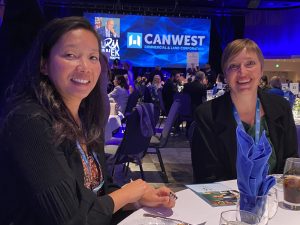
Last night, entrepreneurs, including proteges and mentors, gathered to celebrate the 27th Annual Raj Manek Memorial Banquet at Prairieland Park. Some details follow in “Shop News” and in future blog postings!

In “Article One” of this issue, I share from Montreal copywriter (and blogger) Nick Usborne five reasons that we must balance our use of AI (e.g. ChatGPT) with  Emotional Intelligence (EQ). Whatever tech developments arise, EQ remains indispensable to our work as communicators.

In “Storytellers’ Corner,” I forward Penny McKinlay’s recommendation on the importance of reading from contemporary Italian poet, Alba Donati.

And in “Shop News,” I feature “Entrepreneur of the Month,” Barry Frain, who specializes in customs consulting and education resource development for highway carriers (to meet the reporting obligations of US Customs and Border Protection; and of Canadian Border Services Agency).  I also thank fellow entrepreneurs and service providers for sharing their time and resources with me.

May the best of autumn–the crisp fall air, crimson leaves, compelling new books, programs and more–be with you, good readers, as we  complete the final third of our revolution around the sun. (Where did 2023 go?)

And may each of us feel gratitude for the blessings that we sometimes fail to notice, but which continue to grace our lives, even (or especially) in challenging times.

Sincerely,

Elizabeth

Principal,

Storytelling Communications

www.elizabethshih.com

++++++++

IN THIS ISSUE:

ARTICLE 1:Why does AI need Emotional Intelligence? Five reasons that creatives should know, from Nick Usborne

STORYTELLERS’ CORNER:

Why bother reading? A response from Italian poet, Alba Donati

SHOP NEWS

ABOUT US

++++++++

Article One:  “Why does AI need Emotional Intelligence? Five reasons that creatives should know, from Nick Usborne”

Back in the years 2010 and 2011, I trained as a copywriter through online programming of the American Writers and Artists’ Institute (AWAI), based in Florida.

One of AWAI’s chief training copywriters (and program developers) at the time was Montreal-based Nick Usborne.

Fast-forward about 13 years and Usborne continues to share his ever-current insights on marketing copy for our digital world.

In several of his recent blog postings, he has argued that we cannot afford to ignore Artificial Intelligence (AI). Its influence on communications, marketing (and pretty much everything) is huge.

But Usborne equally insists that we must add Emotional Intelligence (EQ) when we use AI:

While tools like ChatGPT can provide us with great and creative ideas, Usborne contends that “there’s one thing [AI is] really, really bad at: Emotion.”

The “bots” simply don’t handle emotion. So they don’t know how to write with “Emotional Intelligence” (EQ).

Usborne says that AI has “no first-hand experience of emotions. Lines of code can’t fall in love or laugh.”

So they can’t feel empathy for others: “Lines of code don’t care about people, and how they feel.” In theory, then, AI code could remind you of media reports on the hollowed-out personalities of psychopaths.

We really can’t rely heavily on ChatGPT or other sources of AI as they stand, because content that does not emotionally connect with readers has little use to us.

But Usborne says the antidote to soulless bot-generated, unmodified (AI) copy is “Emotionally Intelligent writing.”

He shares five (5) ways in which Emotional Intelligence can “raise the bar way above what AI alone can achieve.”

I highlight and amplify his points with examples from my reading and copywriting:

#1 – Emotionally Intelligent writing empathizes with its readers.

Empathy rather than AI is magical, Usborne contends. When you recognize how your audience feels, you can show that you hear and understand them.  You can write in ways that respect and mirror those feelings. That empathy sells. And it can’t be displaced. Usborne calls it “future-proofing” marketing.

Remember Maya Angelou’s statement on the power of emotion: “People will forget what you said, people will forget what you did, but people will never forget how you made them feel.”

When you acknowledge readers’ feelings, Usborne writes, you “validate” their experience, and from there, you’ll have them eating out of your proverbial hand.

Writing with EQ (emotional intelligence) allows you to secure readers’ engagement, attention and memory.

#2 – Emotionally Intelligent writing stimulates readers’ trust.

When people feel heard and understood, they trust you more deeply than they did before.

Building trust (recall Cialdini’s writing on persuasion) is essential to the processes of marketing. Even if you have a great service and amazing ideas for marketing it, if your reader doesn’t trust you, you’ll flounder. Prospects will only buy when they know, like and TRUST you.

As Usborne writes, “Emotional Intelligence comes to the rescue. Emotionally intelligent writing connects with readers at a deep level and fosters and communicates a sense of authenticity and sincerity. It builds trust.”

#3 – Emotionally Intelligent writing is more easily remembered.

Usborne reminds us that emotions play a large role in how human memory is formed and then repeat in our minds, often for many years.

So when we read slick direct marketing promotions, our memory of that material “disappears within minutes, if not seconds.”

But when marketing captures a prospect’s emotions, it lodges in their memories in more lasting ways. If we remember commercials from our childhood or youth, Usborne observes, we know they were emotionally intensive to us.

Remember some of the favourites (such as those featured by Terry O’Reilly’s program, “Under the Influence?”)?

Such as “Mikey” who liked “Life” cereal? (“He likes it! Mikey likes it!” circa 1971-1984).

Or Michelin tires, “Because so much is riding on your tires” (circa 1987).

Life cereal’s ad powerfully connects a pleasant taste with habit formation for children; and the Michelin tagline connects tires with the safe travel of children, for anxious parents. In both cases, the marketing plucks on our heartstrings. We remember those advertisements, 20+ years later.

Now think about the lack of emotional connection we feel when skim-reading a Readers’ Digest sweepstakes’ direct mail letter (sent via email)—we forget such promotions, a mere 10 seconds later.

#4 – Emotionally Intelligent writing builds a reader’s sense of community.  

Usborne says that when we share feelings with others, we connect with them, and feel we belong to a family or group with them. Why else are there book clubs and online dating websites, and social media like TikTok and texting services like WeChat and What’sApp?

Why is it that most online English as a Second Language (ESL) classes are based on conversation, instead of traditional instruction of grammar or writing?

Why do we labour so hard to develop (and maintain) a prospect list for our marketing messages? When we feel empathy for our prospects, we share community with them.

This is why emotionally intelligent writing is so powerful when you’re trying to build community.

And when people feel they are part of a community, they allow that belonging to influence their purchasing decisions. We all know that we’re more likely to buy products and services recommended by our colleagues.

In 2019 When Jenn Sharp launched her book Taste of Saskatchewan partly online (due to Covid), we found our wish for belonging fulfilled by the heartwarming stories she tells of Saskatchewan farmers and foodies. After listening to Sharp read some of her profiles, I remember calling the book “a love letter” to the SK food industry–and the tagline stuck! The book is all about emotions and community.

#5 – Emotionally intelligent writing better persuades your readers. 

Copywriting 101 tells us that we best persuade others to buy our products or services by appealing to their feelings.

“At its most basic level,” Usborne says, “we buy something because it makes us feel good.” The marketing of products and services must convince us that we should buy these things because they’ll make us look better and be healthier and happier.

So we pay extra for that salon shampoo or the name-brand anti-sensitivity toothpaste.

Writing with emotional intelligence intensifies the emotional lure of our marketing. Writing with EQ “increases conversation rates ” beyond what AI can do, Usborne says.

“AI writing alone can achieve NONE of this,” he says. Tools like ChatGPT are now a daily reality for copywriters and content writers.

He concludes: And that’s fine… just so long as we understand that relying exclusively on AI isn’t the answer. . . . . AI has zero Emotional Intelligence.

That’s why the future lies with writers who combine the efficiencies and other benefits of AI with the emotional power of Emotional Intelligence.

To master this winning combination, you need to learn how to fuse AI with EQ.”

++++++++

If the development of AI has you feeling queasy about the future marketing of your product or service, please consider picking up Usborne’s new course, Futureproof Copywriting(Please note: Although I’ve met Usborne and studied his “Web Copywriting” program, I am not affiliated with him and do not benefit from the sales of his training materials or coaching.)

You’ll want to avoid relying on lists of “Killer Prompts” (reminiscent of keyword stuffing for SEO).

Instead, we all need to develop a “writing process” and practice that includes both ChatGPT and Emotional Intelligence (EQ).

Otherwise, our copy will be predictable, bland and will discourage customers from engaging.  Your features and benefits won’t be remembered, discussed or shared—at the cost of engagement, trust and community.

The answer to “future-proof” your copywriting, Usborne concludes, is to infuse AI with EQ… Emotional Intelligence.

He testifies that he uses ChatGPT and GPT-4 to help with research and audience analysis. I use [AI] to outline articles, presentations, and reports. I even use it – sometimes – to write and rewrite early drafts.

But I NEVER use ChatGPT to write a final draft.

We know that computers can recognize and respond to consumers’ emotions by gathering and evaluating data like facial expressions, gestures, tones of voice, the force of one’s keyboarding and so on.

But AI cannot itself create those emotions.

So whatever anxiety AI brings us as creatives, not to mention those of us familiar with publishing both business and academic articles or books, Usborne insists that we can (and must) learn how to tap into AI without it replacing us, “today or in the future.”

And now it’s your turn: Have you noticed the emotionless quality of AI-generated writing?

Do you agree with Usborne that we must change it, if we want to appeal to our readers and create work that matters?

What strategies have you used to infuse AI with EQ? 

Please write in; I’d be delighted to hear from you. 

+++++++

STORYTELLER’s CORNER . . . . 


STORYTELLER’S CORNER: Words, Stories, Riddles and Jokes on Writing, Reading and Editing . . .

This month: Why bother reading? A response from contemporary Italian poet, Alba Donati 

With the new program (and academic) year just begun, many of us (not only students) are delving into libraries and bookstores to fuel our reading habits!

Reader, blogger and European house-sitter, Penny McKinlay, recently recommended a memoir by Italian poet, Alba Donati, who opened a bookstore in a small Italian village on the cusp of the Covid Pandemic. Facing that challenge, the store only “stayed open thanks to booklovers and local residents” (writes McKinlay).

Donati’s book, Diary of a Tuscan Bookshop: A Memoir, collects her “thoughts about books, community and family” that help us to renew our love of books (McKinlay). Donati takes “an inward look at what we value most in life.”

What better pursuit could any art form prompt?

While I haven’t yet read Diary of a Tuscan Bookshop, you can be sure it’s on my “to do” reading list for this fall! I will pair Donati with Penelope Fitzgerald’s novel, The Bookshop, which was made into an exquisite film (one of my favourite adaptations of all time!) starring Emily Mortimer and Bill Nighy.

McKinlay’s posting about Donati’s memoir caught my attention, since she cites Donati for saying that a good bookshop matters, because it promotes thoughtful reading:

A bookshop is a school—a window looking out on a world that we only think we know. But to really understand the world we have to read, because those who write are always inspired by something that doesn’t quite fit the mold. And when things don’t add up, authors must face the paradox of life and venture into the darkness of the human mind—become at one with that darkness, even—there is no other way (Donati).

Donati could be thinking of some of the novels of British Modernism, including those of Virginia Woolf, who wrote that her focus was on “the dark places of psychology.”

An individual book and an individual bookshop may not seem like much in the larger scale of human life, especially in these tech-intense days. But in reality, both are essential to our understanding of the world and the places we hold in it.

We’d be hard-pressed to get more relevant than that.

++++++++

SHOP NEWS:

Entrepreneur of the Month” for mid-September is Saskatoon’s founder and managing director of “eManifest Express,” Barry Frain . . . .

Barry Frain brings more than 30 years of customs and transportation experience in the highway carrier, customs broker and importer and exporter sides of the shipping world.

He worked for more than 10 years for Expert Customs Brokers, George H. Young and Monarch Industries; and then for 17 additional years for TransX Ltd. and N Yanke Transfer—all before launching his own company, “eManifest Express,” in 2016.

He launched his company through the “startSMART” training program of the Praxis School of Entrepreneurship (Nepotism alert–haha!—I facilitated writing workshops for the cohort that included Barry in 2017).

So what is “eManifest”? It is a mandatory screening tool used by customs to assess the risk of shipments, conveyances (i.e. means of transportation or carrying goods), drivers & passengers that enter into the U.S. or Canada.

“eManifest Express” provides a powerful web-based software as a service (SaaS), customs consulting and education resources that highway carriers use to meet both their US Customs and Border Protection (CBP) and Canada Border Services Agency (CBSA) reporting obligations.

Developing educational resources requires a “measured approach,” Barry says, since carrier regulations have moving parts, and in some cases, knowledge can be elusive.  He suggests a course developer should consider the laws and regulations; directives; specific procedures and timelines; port policies and potential customs penalties when creating a course.

On the other hand, Barry has developed one module in an area that helps carriers meet customs requirements: His “Improve Your Customs Declaration” course provides course participants with a background on the declaration requirements and strategies which can help them meet their obligations.

Of this challenging field of carrier and cross-border transportation and customs, Barry says it’s for “the health, safety and security of Canadian and U.S. citizens that these processes are in place.”

Known for the precision of his technical knowledge, as well as his sense of humour and penchant for satire (e.g. “The Beaverton”), Barry is a family man who recently spent summer holidays among adult kids and grandkids in Northern Saskatchewan.

His only regret, as summer ends, is that he “didn’t have an opportunity to get on the wave runner!”

For more information about Barry’s online courses, please visit:  https://customsforcarriers.ca/

Or reach Barry directly at barry.frain@emanifest.express .

+++++++

In other news this month, I also benefited from (and greatly enjoyed) sharing conversation with Angela Jamieson and her mother, Mrs. Yen Fung (a leader in our province’s Chinese community and former long-time owner of Saskatoon’s “Genesis” restaurant).

Both friends discussed entrepreneurial ventures and family developments with me, over coffee on a busy afternoon in early September.

Of particular interest was Angela’s commitment to memoir writing (spawned by years of travelling the world as an engineer with her young family); her “Transformational” consulting program; and other publishing ventures.

I was also delighted to have Angela join me last night at the 27th Annual Raj Manek Memorial Banquet (September 14th)! It’s hard to imagine that we have been (long distance) friends since we met as 14 year-olds at Aden Bowman Collegiate!

And we resumed our friendship six or seven years ago, after connecting at a prior Raj Manek Memorial Banquet, when Angela’s husband, Pat Jamieson, was in the program. (Small world!)

+++++++

Special thanks this  month to Kanchan Manek, and the Manek family (including Raj, Sona and Kinjal) for organizing and hosting the 27th annual Raj Manek Memorial Banquet last night (at Prairieland Park). The keynote speaker, Sam Kolias, CEO of Boardwalk REIT, said that entrepreneurs should never focus on the “bottom line,” because  “if you focus on profit, you’ll fail.”

Kolias spoke of the “Four Ps” as essential to all entrepreneurs: (i) Purpose (being motivated by love for all); (ii) People (caring for and serving others, including the homeless and those without health); (iii) Our Planet (caring for our environment); and (iv) Place (valuing our communities and understanding and accepting others, instead of judging them).

One year, many of us proteges would delight in hearing Kent Smith-Windsor give the keynote address, and ditto for Monica Kreuger and Silvia Martini!

At the banquet, I had the pleasure of reconnecting  with mentors and proteges, past and present—including Monica Kreuger (as always), Deanna Litz and Rick Cumbers, Kirk Backstrom and Bing Yan, Lauren Penner, Gabriela Leal,  Jolene Watson, Karla Combres and Mario Dima.

+++++++

I’m happy these days to be teaching ESL students from various parts of Africa and Asia. In that context, I’m especially grateful to the IT support staff at the Saskatoon Public Library, who actively support  newcomers in using the library’s digital resources.

These include showing and helping them download apps to improve newcomers’ English skills (e.g. “Hoopla,” “Libby” and “Mango Languages”).

And various branches of our public library also provide common meeting space for language classes, with great Wi-Fi and welcoming staff.

Under the organization of Saskatoon Open Door Society’s Lisa Focardi, the J.S. Wood branch, for instance, has hosted one of the organization’s  most popular “Conversation Circles.”

Thank you to the staff of Saskatoon’s Public Libraries, who strive to accomplish much in our communities, including for newcomers.

++++++++

There are always new entrepreneurs and entrepreneurial success stories to celebrate. Please send me yours to share in future issues!

But for now, this is a wrap for mid-September!

++++++++
ABOUT US:

Between 2011 and December 2018, Elizabeth Shih Communications chronicled the stories of B2B marketing and communications on the Prairies and across the country.

Effective January 1, 2019, I rebranded as “Storytelling Communications.” I now help new and economic immigrants to secure better jobs by improving their language skills: I assist SMEs in closing more sales by communicating more effectively; and I help major companies write their legacy stories.

Interested in learning more? Please contact me through my CASL-compliant website (www.elizabethshih.com).

After I receive your message, I’ll be pleased to discuss projects with you!

Please visit my website for more information (www.storytellingcommunications.ca).


“As far as you can possibly go, +1”: Winding up summer reading and imagination (with Terry O’Reilly)–revisiting June, 2019

Recently, Terry O’Reilly replayed a classic episode of his show on marketing, “Under the Influence” from June 2019. As we say good-bye to summer 2023, I’m returning us to Terry’s brilliant insight that imagination can “change the world.”

During the past busy year, filled with training, teaching and writing, I haven’t often managed to tune in to O’Reilly. Thankfully, through the great podcasts that he produces for the award-winning (CBC) radio show, we can always catch up later. 

It’s been my intention to do so for some weeks. And then last Sunday, my friend Martha Fergusson observed that Terry’s “Bookmarks 2019” episode was especially “wonderful”—his annual show that collects the “outtakes” and extras that didn’t fit into earlier episodes of the season—not because they were weak or had errors, but because they came from books and sources that simply didn’t fit the topics of earlier shows.

And was Martha right!

When I listened to the episode today, I realized why O’Reilly is my kind of marketer. He celebrates reading by saying that “books are barbells for the mind. The best kind of books on marketing are the ones that aren’t books about marketing. Marketing is the study of what makes us tick.” . . . . Such books are about “authors sharing insights about the human condition.”

Marketing, entrepreneurship, media and the Arts can’t get any better than that.

“Bookmarks 2019” spans a gamut of O’Reilly (and his team’s) reading, all of which vivifies the human condition.  He lists a catalog on unconventional book clubs from around the world that get people reading and meeting; he describes the surprisingly tense core casting of the film version of To Kill a Mockingbird that made its success; we hear from a biography of Beatles’ producer George Martin that only a slight, chance conversation caused him to produce “The Fab Four,” against the odds; and we watch a clip of the “Mary Tyler Moore Show,” directed by the gutsy Joan Darling on the taboo topic of morbidity (“Chuckles [the Clown] Bites the Dust”)—now immortalized as a classic of television.

Citing Dave Trott’s book, Predatory Thinking, O’Reilly observes that in marketing and other creative activity, we tend to make decisions based on our limited experience and knowledge which shut down imagination. He notes that “in business it’s often seen as a sign of strength to have an immediate opinion on everything. But the problem with that is that it shuts down exploration. We all have blindspots” that limit our capacity to see creatively. “Quick opinions too easily slam the door on potential.”

He says: “It can be much more powerful sometimes to say ‘I don’t know.’ ” As the old adage has it, “We don’t know what we don’t know” (an expression recapitulated in the theme song of the community, “Happy Place,” of another classic sit-com,“Corner Gas,” as “I don’t know the same things you don’t know.”)

O’Reilly insists that “ ‘I don’t know’ opens a door.” That door can trigger imagination.

“Imagination is always as far as you can possibly go, +1.” And “that +1 can change the world.”

He concludes that “when judging creativity, you have to keep your antennae fully tuned for the smallest indication of massive potential.”

There is risk involved in engaging imagination–and (I add) consider how that is now affected by Artificial Intelligence (AI–ChatGPT)! But “risks become calculated risks when experienced hands are on the steering wheel.” It’s useful to tap into AI, but even AI (at this time) will often lack the spontaneity and insight of our own imaginations.  AI is a useful, even necessary, tool, but it won’t suffice unless accompanied, adapted and modified, by that “+1.” And by reading and reading even more, the application of what we read spawns precisely that experience.

So whether you’ve been on the beach or in your office this summer, when reading, consider that in the crucibles of each of our creative work, we need to imagine options “as far as we can go, +1.”

Check out Terry’s “Bookmarks” episode, below:

https://www.cbc.ca/radio/undertheinfluence/this-tv-episode-is-considered-the-greatest-of-all-time-1.5155531

And now it’s your turn: What are you doing that goes “as far as you

can go, + 1?”

Please write on my “contact” page.  I’d be delighted to hear from you.

Want your stories to succeed? Build them on ideas that “stick,” say Chip and Dan Heath (from July, 2020)

I often blog on issues pertaining to stories and storytelling. But when blogging, I  haven’t  actually discussed what constitutes a “good” (or compelling) story.

Thirteen years ago, Chip Heath (a professor of organizational behaviour at Stanford University) and his brother, Dan Heath (a senior fellow in social entrepreneurship at Duke University), combined their research interests and wrote Made to Stick: Why some ideas take hold and others come unstuck (London: Penguin/Arrow, 2007).


The book, which has fascinated entrepreneurs, authors from multiple fields, researchers and academics alike, asserts one overarching tenet: Thinking, writing and other endeavours that provide “sticky ideas” (i.e. ideas that succeed by becoming popular and influential in contemporary culture) all exhibit the following six principles (“SUCCES”):

  1. They are simple.
  2. They are unexpected.
  3. They are concrete.
  4. They are credible.
  5. They are emotional.
  6. They have the structure of a story.     The Heaths say that the extent to which ideas are interesting (“Are ideas born interesting or made interesting?”) conforms to the ol’ nature vs. nurture debate. Say the Heaths: “This is a nurture book.”So we can all nurture our ideas so that they’ll become successful in the world.Right.

    But it’s not that easy, is it, or we’d all already be doing it (and often).

    The Heaths qualify that “there is no ‘formula’ for a sticky idea. . . . But sticky ideas do draw from [this] common set of traits [SUCCES], which makes them more likely to succeed.”

    (1) To aim for simplicity is not to “say it short,” but to craft our ideas to be “both simple and profound.” This amounts to crafting “a one-sentence statement so profound that an individual could spend a lifetime learning to follow it.” Think “proverb,” not “sound bite.” Consider Pareto’s Law, that (I paraphrase here) “80% of consequences come from 20% of the causes” (an unequal relationship between inputs and outputs).

    (2) To aim for unexpectedness, we have to get our prospects’ (or readers’) attention, keep their interest and raise curiosity for the time it takes to get our ideas across.

    An unexpected idea must “violate people’s expectations.” It has to be counterintuitive (e.g. the idea that a bag of movie theatre popcorn is “as unhealthy as a whole day’s worth of fatty foods” [16]). We can engage people’s curiosity over longer periods of time by “systematically opening gaps in their knowledge—and then filling those gaps.”

    (3) To aim for concreteness, we have to make our ideas clear by explaining them in terms of human action that involves sensory information. For instance, the urban legend that people were inserting razors in apples to poison children on Hallowe’en is compelling because it is concrete and “our brains are wired to remember concrete data.” Concrete language is needed if our idea is going to “mean the same thing to everyone in our audience.”

    (4) To aim for credibility, our “sticky ideas” have to carry their own authority. The Heaths cite presidential candidate Ronald Reagan as asking voters a simple question (to win the presidential debate against Jimmy Carter) that allowed voters to test the idea for themselves and find it  credible: “Before you vote, ask yourself if you are better off today than you were four years ago.”

    (5) To make an idea sticky, we have to make our audience feel something and to feel it “for people, not for abstractions.” It can be hard to find “the right emotion to harness.” The Heaths say it wouldn’t work to persuade teenagers to stop smoking by trying to trigger fears for the consequences. But if you “tap into their resentment of the duplicity of Big Tobacco,” you could cause that tide to turn (18).

    (6) To persuade people to act on our ideas, we have to tell stories about them. The Heaths say that firefighters exchange stories after every fire they fight, because doing so creates “a more complete mental catalog of critical situations” they may face, so that they will know how to respond.Researchers have found that mentally rehearsing such situations (in many fields of endeavour) helps us to perform better. And hearing stories “acts as a kind of mental flight simulator, preparing us to respond more quickly and effectively” (18).

    +++++

    Contrary to the average person’s expectations, we don’t need any particular education or expertise to use these six principles. The Heaths remark that many of these principles “have a common-sense ring to them” (18).

    But the reality that we are not swimming in brilliantly designed, sticky ideas, is due to what the Heaths call “the Curse of Knowledge” (19), the fact that “once we know something, we find it hard to imagine what it was like not to know it. Our knowledge has ‘cursed’ us.” The problem that results is that we find it hard to share our knowledge with others, because we “can’t readily re-create our listeners’ state of mind” (20). I’d call this a limit of empathy that can occur when we try to share knowledge.

    The only reliable way to beat this “curse of knowledge,” the Heaths say, is (1) not to learn anything—(generally not a good idea); and (2) to take your ideas and transform them, using the six principles of SUCCES.

    So instead of droning on like a CEO about the importance of “maximizing shareholder value,” JFK in 1961 famously shared his idea for an American moon mission, saying his country’s goal (as a culture) was “to put a man on the moon and return him safely by the end of the decade” (21). This statement checks off all the boxes of SUCCES and escaped the “curse of knowledge.”

    The idea, the Heaths observe, “motivated the actions of millions of people for a decade.” JFK was more intuitive as a leader than the average CEO is, operating today. JFK’s story stuck.

    The Heaths say that we needn’t be highly creative to create sticky ideas—such ideas can be systematically produced. A “paint-by-numbers” approach [seeking factors of SUCCES] will achieve more creative results than a “blank canvas” will.

    So we call can create “sticky ideas” that can make a difference in what we do. “Normal people in normal situations can make a profound difference using their sticky idea” (289).

    Use what sticks.

    Made to Stick has many more, illuminating stories and examples that nuance their six principles and give ordinary readers further substance to contemplate. If you work creatively in any industry (and who doesn’t?), take the time to buy this book and mark it up!

    Make it your creative Bible for your next media release, testimonial, blog posting or other copy—or hire me, so that I can do that for you!

    And now it’s your turn: Can you meditate on your latest project or idea, in the context of Chip and Dan Heath’s six “sticky” principles? How can you strengthen your idea to reflect them?

    The implications are profound—this is much more than just a great “summer read.”

On summer FUN and how to get it, with Catherine Price in the mid-July issue of TYSN

July 2023 Vol 5 Issue 7

Tell Your Story Newsletter (TYSN):

Specializing in Entrepreneurial and Linguistic Communication

Let me teach you to tell your story!

IN THIS ISSUE:

ARTICLE 1: On summer FUN and how to get it, with Catherine Price 

STORYTELLERS’ CORNER:  The case of “lit” and “lighted” from American “Grammar Girl,” Mignon Fogarty

SHOP NEWS

ABOUT US

++++++++

Welcome Mid-July 2023!

When meeting newcomers and visitors to Saskatoon each summer, I often refer to how the full summer days of July are precious in our province. “Do please get outdoors,” I urge those who have just deplaned from China, Pakistan and elsewhere. As I said to a group of newcomers at Saskatoon Open Door’s conversation circle, recently, “Summer helps us to be mindful of such times when we feel fully alive.”

Those born and/or raised in Saskatchewan, often recall the halcyon days of childhood summers. Many of us–likely including you, good reader–do indeed try to get outdoors, between June and September. I walk as much as I can (often ditching sneakers for sandals), take some weekend hours to read the fiction of Saskatchewan authors, eat local produce, teach and tutor English outdoors and slather on sunscreen and bug spray, to keep these times healthy.

Summer often feels like the easiest season of the year in which to live–and one when we can pause long enough to feel fully alive.

And yet, much in the world is not right. With the war in Ukraine; political unrest in multiple world hotspots; extreme weather, due to climate change; and with soaring interest rates and inflation at home . . .  can we be mindful of the gift of life–and grateful for it?

In Article One this month, I re-visit (from November 2022’s issue) journalist Catherine Price’s TEDTalk on the topic of FUN. Price suggests that experiencing some degree of fun preserves our experiences of joy in life, through which we find the resilience we need to cope through challenging times.

And in what better month could we find fun, than in July?

And as I write, good reader, many of us are enjoying some fun this summer, even if we’re limited by our economy and the cost of living. There are movies to watch (even if  summer “blockbusters” let us down); eScooters to try (preferably not on the sidewalk, thank you); camping; cycling; hiking; kayaking; and swimming, to name a few pursuits. . . . And perhaps most importantly, we can always curl up with some great summer reads, with new titles appearing from local authors like Tony Bidulka and Ashleigh Mattern.

But how can we find fun on a regular basis? After defining what the term means, Price gives us some hints.

And in “Storytellers’ Corner,” I visit the sometimes troubling tension between two different past tense formations of the verb “to light.” Should it be “lighted” or “lit,” you might ask? (Which lights you up more?!)

While Covid-19 will always remain with us,  (many of us will queue up for our next vaccination this fall), our fleeting  summer in Saskatchewan still provides some much-needed days of relaxation, even if it’s simply to recline and daydream in our province’s backyards, balconies, parks and patios.

May you have much FUN this month, good reader, to store  in your mind the pleasure and peace that summer can provide! They will help us to complete the next five months of our collective orbit around the sun.

Sincerely,

Elizabeth

Principal

Storytelling Communications

www.elizabethshih.com

++++++++

Article One: From the Archives (2022): On summer FUN and how to get it, with Catherine Price

In her recent TEDTalk, American science journalist Catherine Price observed something that should make us all pause:  “It’s harder than we think it should be to actually feel alive.”

Consider that statement: We’re so busy constantly scrolling (and often “doing” things) that we forget how to live! We forget that life should consist of more than days filled with frenetic activity.

Price says: “We keep ourselves busy to the point of exhaustion. But we’re also languishing. We feel a little bit dead inside.” She thinks we’re living close to despair, staying busy because we know that we are not truly living and we simply don’t know what else to do about it.

Her answer? “We need to have more FUN!”

But what does that mean?

Price argues that our confusion over what actually constitutes “fun” arises from the sloppy way in which we use the term: we often use it to describe leisure activities (e.g. “We had a fun weekend with my in-laws at the family cabin”), when the activity may not be enjoyable–or worse, may even be “a waste of time” (present family, excluded, of course).

Price gives as an example our scrolling through social media, an activity we might assume is “fun,” but which she says often “makes us feel bad about . . . everything.”

Even our best English language dictionaries have trouble defining the term “fun”: According to them,“fun is amusement or enjoyment, or lighthearted pleasure,” and refers to what children “have in the play area.”

Fun seems to be, as Price observes, “frivolous and optional.”

When she was working on her project about fun, collecting stories on the topic from people all over the globe, Price says they would “tell you about some of the most joyful and treasured memories of their lives.”

But such memories are not simply “lighthearted pleasure, not just for kids and . . . definitely not frivolous.”

Price suggests that fun is, in fact, “the secret [to] feeling alive.”

Clearly the term deserves a new, “more precise” definition!

Fun is a feeling, she asserts, not an activity, although when asked to describe “fun,” most people list “dancing” or “skiing,” or “pickleball” as examples.

Some “serendipity” (or downright chance) is involved in the word, since activities or events we expect to be fun often disappoint us, while those we don’t expect to enjoy can become “ridiculously fun.” Sound familiar?

Price says that it’s easy to tell someone who is having fun, because they look as if “they’re being illuminated from within.” True fun “produces [a] visceral sense of lightness and joy.” People can radiate fun.

From her interviews with dozens of people from diverse cultures, Price says that “three factors are consistently present” when we experience fun, yielding a much more accurate definition than what the OED or Webster’s tells us.

These three terms are “playfulness,” “connection” and “flow.” Where these experiences overlap is the space of “true fun”(see the venn diagram below, provided by Price).

Playfulness,” she says, is not playing games or make-believe but “having a lighthearted attitude, of doing things for the sake of doing them and not caring too much about the outcome. Letting go of perfectionism.” Playfulness means not being defensive and “not taking ourselves too seriously.”

“Connection” refers to “the feeling of having a special, shared experience.” It is possible to be alone when this happens (and so to feel connected to oneself and/or to an activity), but most often, another person is involved—“even for introverts.”

Flow” is a state where we’re so intensively engaged and focused on what we’re doing that “we can even lose track of time.” (e.g. “in the zone” as a musician or athlete).

Price argues that “it’s possible to be in flow and not [to] have fun, like if you’re arguing with someone. But you cannot have fun if you’re not in flow,” she says.

Each of these three factors is enjoyable on its own. “But when we experience all three at once, something magical happens: we have fun.” And that “doesn’t just feel good, it is good for us.”

(i) She says that fun is so beneficial that it “ is not just the result of human thriving, it’s its cause.” For instance, fun is “energizing,” so that when people describe such moments, “they glow: It’s like a fire has been lit inside of them and the energy and the warmth they give off is contagious.”

Whereas “so much of life drains us . . . fun fills us up.”

(ii) Fun requires us to be “present,” or in-the-moment, but doesn’t require meditation, yoga, etc. Apart from presence, there’s no other way that fun can arise.

(iii) Fun also unites us in a “really polarized world.” When we have fun with others, “we don’t see them as having different ethnicities or religions from ours. We connect with them as human beings.” She adds that such a connection is the first step whereby we can begin to solve the world’s problems.

(iv) “Fun also makes us healthier.” Isolation and loneliness can cause hormonal changes in our brains and bodies that increase the risk of disease. But when we have fun, we become “relaxed and more socially connected,” both of which are health-giving. So, Price argues, “having fun is a health intervention.”

(v) Finally, fun is “joyful.” While we read books or listen to favourite music, the truth is that “when we are in a moment of having fun, we are happy.” Price says this: The “secret of long-term happiness may be simply to have more everyday moments of fun.”

In order to have “more fun,” she says, we should do all we can to increase our everyday moments of playfulness, connection and flow.

Here are some ways:

(i) Reduce distractions in order to increase flow. Distractions disrupt flow. The chief source of distraction in 2023 is our smartphones. (Act accordingly!)

(ii) Increase connection by interacting more with other human beings in real life. This is easier and less scary than we (huddled over our phones) tend to fear.

Interaction starts by making eye contact with someone. “Say ‘Hello,’” Price advises. If that goes well, introduce yourself. From there, ask an interesting question (e.g. “What’s one thing that delighted you today?”)

(iii) Increase playfulness “by finding opportunities to rebel.” This doesn’t mean becoming a total iconoclast, but to show “playful deviance,” to “break the rules of responsible adulthood” and “give yourself permission to get a kick out of your own life.”

(iv) Finally, Price recommends that having fun should be a “priority.” Try to reproduce the circumstances (including other people’s presence) that have created fun for you in the past. Make some time in your schedule to have fun. “Treat fun as if it’s important, because it is,” she enthuses.

Fun brings “more creativity, more productivity, more resilience,” Price says. Fun can make us, as she claims,  a better spouse, parent and friend.

Fun is needed during every month of the calendar, but reading Price’s insights on it may help you enjoy summer even more!

Fun, she concludes, for anyone still puzzled by it, is “a distillation of life’s energy. And the more often we experience it, the more we will feel that we are actually alive.”

Now what would be better than that, this summer?

And now it’s your turn: do you agree with Price’s definition of fun and why it matters? 

Please write in; I’d be delighted to hear from you!

++++++++

STORYTELLERS’ CORNER . . . . 

STORYTELLERS’ CORNER: Words, stories, riddles and articles on speaking, listening, writing and editing . . .

The case of “lit” versus “lighted,” with America’s “Grammar Girl,”

Mignon Fogarty

In a recent blog on modern English usage, American wordsmith, “Grammar Girl” Mignon Fogarty, observed that there are now two forms in use of the simple past tense of the verb “to light.” Have you noticed this?

I overheard someone in a local cafe recently, commenting that the smile of her (undisclosed) partner “lighted up the room.” That form of the simple past tense was grating, and I thought to myself, “it should be ‘lit up the room!’ ”

But Mignon Fogarty suggests otherwise. In her blog this week, she writes that “to light” is a “regular verb,” so that we can write its simple past tense by adding “-ed.” Therefore, we can correctly say and write “lighted.”

However, we can continue to use “lit” for the past tense, which remains the more common form.

Fogarty says that in ancient times, “people said they lit candles.” Over time, people started saying they “lighted candles.” Unusually, “around 1900, people switched back to using ‘lit’ as the past tense.” While “lit” remains “the more common form today,” “lighted” is not incorrect.

Has this usage tip enlightened you? Which form best lights you up (Ha ha!)?

Do you have an, idea, problem or joke involving any aspect of language or communications? Please share it with me; I’d be delighted to use it in an upcoming issue. 

++++++++

SHOP NEWS:

My candidate for “Entrepreneur of the Month” was unable to share his information in time for press, but no matter.

Special thanks go out this month to Lisa Focardi, Community Development Worker at Saskatoon’s Open Door Society (SODS). An Italian-Canadian immigrant, Lisa capably organizes (amongst many programs) the volunteer-led conversation circles, throughout the calendar year.

Her organizational efforts and generosity with others make sharing conversation skills with newcomers a great pleasure. Thank you, Lisa!

Are you a native speaker or are you otherwise fluent in English? Do you have 60-90 minutes each week to share your skills with others? Please drop me a line and I will connect you with Lisa, who is always glad to have more volunteers on board.

++++++++

And hearty congratulations to my colleague and friend, the multi-talented writer, web designer and athlete, Ashleigh Mattern, who recently launched her first novel, a young adult fantasy, called Magicked Born. Reading to a packed room at McNally Robinson on June 28th, Mattern spoke about various aspects of writing fantasy, including how journalism has contributed to the process.

I recommend Magicked Born highly (it’s a page turner!) and congratulate Mattern for not abandoning the project (which was under development over some 15 years), even when other work and life seemed to move in non-conducive directions. Congratulations, Ashleigh!

++++++

And special thanks this month to Professor Emeritus, Bob Calder, and fellow writer, Paula Jane Remlinger, who recently shared a lovely, very FUN two-hour visit with me, over summer refreshments.

We reminisced a little about our past studies,  favourite writers and current projects, thereby bridging the gap between  Calder’s extensive academic career and the non-academic writing that Remlinger and I (former students) now do.

Catherine Price would have approved of flow, connection and simple playfulness of our conversation.

Remlinger writes and publishes poetry and fiction, while also penning reports for a living, for the SK Human Rights’ Commission.

Calder (“Bob” to us)  has just completed the editing of a scholarly book on the film adaptations of  W. Somerset Maugham’s novels, which is forthcoming from the U of Wisconsin Press. He is also deeply involved in writing a memoir of his 40+ year career as a university English teacher.

I  cannot imagine two more engaging  interlocuters than these two, on a quiet July afternoon. All three of us left the table energized to return to our reading and writing!

Thank you, to both Bob and Paul Jane. And let’s meet again before winter returns . . . .

++++++++

There are always new businesses, people, non-profits and entrepreneurial programs to promote.   

Please write me to share your success stories!

I’m excited for what’s ahead in our entrepreneurial and literary community.

But for now, this is a wrap for mid-July!

ABOUT US:

Between 2011 and December 2018, Elizabeth Shih Communications chronicled the stories of B2B marketing and communications on the Prairies and across the country.

Effective January 1, 2019, I rebranded as “Storytelling Communications.” I now help local newcomers to secure better jobs by improving their language skills; I help SMEs close more sales by communicating more effectively; and I tell the legacy stories of major companies.

Interested in learning more? Please contact me through my CASL-compliant website (www.elizabethshih.com).

After I receive your message, I’ll be pleased to discuss projects with you!

Please visit my website for more information (also to be found at  www.storytellingcommunications.ca).


TEFL.org’s teacher and podcaster, Carl Cameron-Day, on his career teaching English as a Second/Foreign Language

These days, any fledgling teacher in English as a Second Language (ESL) or English as a Foreign Language (EFL) seeks online options for training and professional development. During earlier days of the Covid-19 pandemic, online learning was the only way students of all ages and homelands were able to learn anything.

On both scores, a great resource is TEFL.org, whose flagship 120 hour ESL/EFL training program (all done online) provides any wannabe teacher with the fundamentals of grammar, style, lesson planning, teaching methods and more that one needs to succeed.

I was part way through my 120 hour certificate in 2020 when  I noticed that TEFL.org was sharing wonderful professional development for anyone visiting their website and their webinars on YouTube and Facebook.  The webinars (which are open to anyone) have been hosted by Northern Ireland-based EFL/ESL expert, Carl Cameron-Day. I’ve tuned in most Fridays since, live at 4:00 pm (UK time), to listen to Carl’s teachings and–even better– his advice during the Q&A that follows.

I’ve appreciated Carl’s down-to-earth manner, pleasant accent (Welsh), mischievous (often tongue-in-cheek) sense of humour and (most importantly) insights in the field of English as a second or foreign language.

I’ve also been delighted to find TEFL.org’s podcast, “I Taught English Abroad,”  featuring a variety of TEFL.org owners, administrators, trainers and more, who share aspects of their English teaching lives, which have spanned the globe.

Wanderlust can be a major driver for newbie EFL/ESL teachers. Now that I’m middle-aged, I’m no longer bitten by the “travel-bug” to backpack through Europe, Asia or elsewhere. But I still appreciate hearing about other EFL/ESL teachers’ experiences–whether based in their countries of origin (not always English speaking nations), or in the travel they do as nomadic teachers.

This week, I smiled to read that Carl himself would be interviewed for TEFL.org’s “I Taught English Abroad” podcast series. Here’s  the marketing promo: “Carl’s ruthless academic determination and wanderlust have seen him teach in some of the less-heralded but most eye-catching locales in the world, including Iraq, Azerbajan, plenty of East Asia and now, from the comfort of his home office [near Belfast].”

Are you or someone you know interested in teaching EFL/ESL, especially while travelling the world? Or do you simply love to hear great stories?

If so, you won’t want to miss this episode (available on both Apple Podcasts and Spotify)!

Take a listen!  . . .  https://tinyurl.com/528frek6