Why does AI need Emotional Intelligence? Five reasons from Nick Usborne in the mid-September issue of TYSN

September 2023 Vol 5 Issue 9

Tell Your Story Newsletter (TYSN):

Specializing in Linguistic and Entrepreneurial Communication

Let me teach you to tell your story!

Welcome Mid-September 2023!

As I prepare this issue of “Tell Your Story Newsletter,” the heat waves of July and August have passed, and more of  the brisk autumnal air we associate with September has come!

I hope that the new program and academic year has begun well for you, good readers.

Last night, entrepreneurs, including proteges and mentors, gathered to celebrate the 27th Annual Raj Manek Memorial Banquet at Prairieland Park. Some details follow in “Shop News” and in future blog postings!

In “Article One” of this issue, I share from Montreal copywriter (and blogger) Nick Usborne five reasons that we must balance our use of AI (e.g. ChatGPT) with  Emotional Intelligence (EQ). Whatever tech developments arise, EQ remains indispensable to our work as communicators.

In “Storytellers’ Corner,” I forward Penny McKinlay’s recommendation on the importance of reading from contemporary Italian poet, Alba Donati.

And in “Shop News,” I feature “Entrepreneur of the Month,” Barry Frain, who specializes in customs consulting and education resource development for highway carriers (to meet the reporting obligations of US Customs and Border Protection; and of Canadian Border Services Agency).  I also thank fellow entrepreneurs and service providers for sharing their time and resources with me.

May the best of autumn–the crisp fall air, crimson leaves, compelling new books, programs and more–be with you, good readers, as we  complete the final third of our revolution around the sun. (Where did 2023 go?)

And may each of us feel gratitude for the blessings that we sometimes fail to notice, but which continue to grace our lives, even (or especially) in challenging times.

Sincerely,

Elizabeth

Principal,

Storytelling Communications

www.elizabethshih.com

++++++++

IN THIS ISSUE:

ARTICLE 1:Why does AI need Emotional Intelligence? Five reasons that creatives should know, from Nick Usborne

STORYTELLERS’ CORNER:

Why bother reading? A response from Italian poet, Alba Donati

SHOP NEWS

ABOUT US

++++++++

Article One:  “Why does AI need Emotional Intelligence? Five reasons that creatives should know, from Nick Usborne”

Back in the years 2010 and 2011, I trained as a copywriter through online programming of the American Writers and Artists’ Institute (AWAI), based in Florida.

One of AWAI’s chief training copywriters (and program developers) at the time was Montreal-based Nick Usborne.

Fast-forward about 13 years and Usborne continues to share his ever-current insights on marketing copy for our digital world.

In several of his recent blog postings, he has argued that we cannot afford to ignore Artificial Intelligence (AI). Its influence on communications, marketing (and pretty much everything) is huge.

But Usborne equally insists that we must add Emotional Intelligence (EQ) when we use AI:

While tools like ChatGPT can provide us with great and creative ideas, Usborne contends that “there’s one thing [AI is] really, really bad at: Emotion.”

The “bots” simply don’t handle emotion. So they don’t know how to write with “Emotional Intelligence” (EQ).

Usborne says that AI has “no first-hand experience of emotions. Lines of code can’t fall in love or laugh.”

So they can’t feel empathy for others: “Lines of code don’t care about people, and how they feel.” In theory, then, AI code could remind you of media reports on the hollowed-out personalities of psychopaths.

We really can’t rely heavily on ChatGPT or other sources of AI as they stand, because content that does not emotionally connect with readers has little use to us.

But Usborne says the antidote to soulless bot-generated, unmodified (AI) copy is “Emotionally Intelligent writing.”

He shares five (5) ways in which Emotional Intelligence can “raise the bar way above what AI alone can achieve.”

I highlight and amplify his points with examples from my reading and copywriting:

#1 – Emotionally Intelligent writing empathizes with its readers.

Empathy rather than AI is magical, Usborne contends. When you recognize how your audience feels, you can show that you hear and understand them.  You can write in ways that respect and mirror those feelings. That empathy sells. And it can’t be displaced. Usborne calls it “future-proofing” marketing.

Remember Maya Angelou’s statement on the power of emotion: “People will forget what you said, people will forget what you did, but people will never forget how you made them feel.”

When you acknowledge readers’ feelings, Usborne writes, you “validate” their experience, and from there, you’ll have them eating out of your proverbial hand.

Writing with EQ (emotional intelligence) allows you to secure readers’ engagement, attention and memory.

#2 – Emotionally Intelligent writing stimulates readers’ trust.

When people feel heard and understood, they trust you more deeply than they did before.

Building trust (recall Cialdini’s writing on persuasion) is essential to the processes of marketing. Even if you have a great service and amazing ideas for marketing it, if your reader doesn’t trust you, you’ll flounder. Prospects will only buy when they know, like and TRUST you.

As Usborne writes, “Emotional Intelligence comes to the rescue. Emotionally intelligent writing connects with readers at a deep level and fosters and communicates a sense of authenticity and sincerity. It builds trust.”

#3 – Emotionally Intelligent writing is more easily remembered.

Usborne reminds us that emotions play a large role in how human memory is formed and then repeat in our minds, often for many years.

So when we read slick direct marketing promotions, our memory of that material “disappears within minutes, if not seconds.”

But when marketing captures a prospect’s emotions, it lodges in their memories in more lasting ways. If we remember commercials from our childhood or youth, Usborne observes, we know they were emotionally intensive to us.

Remember some of the favourites (such as those featured by Terry O’Reilly’s program, “Under the Influence?”)?

Such as “Mikey” who liked “Life” cereal? (“He likes it! Mikey likes it!” circa 1971-1984).

Or Michelin tires, “Because so much is riding on your tires” (circa 1987).

Life cereal’s ad powerfully connects a pleasant taste with habit formation for children; and the Michelin tagline connects tires with the safe travel of children, for anxious parents. In both cases, the marketing plucks on our heartstrings. We remember those advertisements, 20+ years later.

Now think about the lack of emotional connection we feel when skim-reading a Readers’ Digest sweepstakes’ direct mail letter (sent via email)—we forget such promotions, a mere 10 seconds later.

#4 – Emotionally Intelligent writing builds a reader’s sense of community.  

Usborne says that when we share feelings with others, we connect with them, and feel we belong to a family or group with them. Why else are there book clubs and online dating websites, and social media like TikTok and texting services like WeChat and What’sApp?

Why is it that most online English as a Second Language (ESL) classes are based on conversation, instead of traditional instruction of grammar or writing?

Why do we labour so hard to develop (and maintain) a prospect list for our marketing messages? When we feel empathy for our prospects, we share community with them.

This is why emotionally intelligent writing is so powerful when you’re trying to build community.

And when people feel they are part of a community, they allow that belonging to influence their purchasing decisions. We all know that we’re more likely to buy products and services recommended by our colleagues.

In 2019 When Jenn Sharp launched her book Taste of Saskatchewan partly online (due to Covid), we found our wish for belonging fulfilled by the heartwarming stories she tells of Saskatchewan farmers and foodies. After listening to Sharp read some of her profiles, I remember calling the book “a love letter” to the SK food industry–and the tagline stuck! The book is all about emotions and community.

#5 – Emotionally intelligent writing better persuades your readers. 

Copywriting 101 tells us that we best persuade others to buy our products or services by appealing to their feelings.

“At its most basic level,” Usborne says, “we buy something because it makes us feel good.” The marketing of products and services must convince us that we should buy these things because they’ll make us look better and be healthier and happier.

So we pay extra for that salon shampoo or the name-brand anti-sensitivity toothpaste.

Writing with emotional intelligence intensifies the emotional lure of our marketing. Writing with EQ “increases conversation rates ” beyond what AI can do, Usborne says.

“AI writing alone can achieve NONE of this,” he says. Tools like ChatGPT are now a daily reality for copywriters and content writers.

He concludes: And that’s fine… just so long as we understand that relying exclusively on AI isn’t the answer. . . . . AI has zero Emotional Intelligence.

That’s why the future lies with writers who combine the efficiencies and other benefits of AI with the emotional power of Emotional Intelligence.

To master this winning combination, you need to learn how to fuse AI with EQ.”

++++++++

If the development of AI has you feeling queasy about the future marketing of your product or service, please consider picking up Usborne’s new course, Futureproof Copywriting(Please note: Although I’ve met Usborne and studied his “Web Copywriting” program, I am not affiliated with him and do not benefit from the sales of his training materials or coaching.)

You’ll want to avoid relying on lists of “Killer Prompts” (reminiscent of keyword stuffing for SEO).

Instead, we all need to develop a “writing process” and practice that includes both ChatGPT and Emotional Intelligence (EQ).

Otherwise, our copy will be predictable, bland and will discourage customers from engaging.  Your features and benefits won’t be remembered, discussed or shared—at the cost of engagement, trust and community.

The answer to “future-proof” your copywriting, Usborne concludes, is to infuse AI with EQ… Emotional Intelligence.

He testifies that he uses ChatGPT and GPT-4 to help with research and audience analysis. I use [AI] to outline articles, presentations, and reports. I even use it – sometimes – to write and rewrite early drafts.

But I NEVER use ChatGPT to write a final draft.

We know that computers can recognize and respond to consumers’ emotions by gathering and evaluating data like facial expressions, gestures, tones of voice, the force of one’s keyboarding and so on.

But AI cannot itself create those emotions.

So whatever anxiety AI brings us as creatives, not to mention those of us familiar with publishing both business and academic articles or books, Usborne insists that we can (and must) learn how to tap into AI without it replacing us, “today or in the future.”

And now it’s your turn: Have you noticed the emotionless quality of AI-generated writing?

Do you agree with Usborne that we must change it, if we want to appeal to our readers and create work that matters?

What strategies have you used to infuse AI with EQ? 

Please write in; I’d be delighted to hear from you. 

+++++++

STORYTELLER’s CORNER . . . . 


STORYTELLER’S CORNER: Words, Stories, Riddles and Jokes on Writing, Reading and Editing . . .

This month: Why bother reading? A response from contemporary Italian poet, Alba Donati 

With the new program (and academic) year just begun, many of us (not only students) are delving into libraries and bookstores to fuel our reading habits!

Reader, blogger and European house-sitter, Penny McKinlay, recently recommended a memoir by Italian poet, Alba Donati, who opened a bookstore in a small Italian village on the cusp of the Covid Pandemic. Facing that challenge, the store only “stayed open thanks to booklovers and local residents” (writes McKinlay).

Donati’s book, Diary of a Tuscan Bookshop: A Memoir, collects her “thoughts about books, community and family” that help us to renew our love of books (McKinlay). Donati takes “an inward look at what we value most in life.”

What better pursuit could any art form prompt?

While I haven’t yet read Diary of a Tuscan Bookshop, you can be sure it’s on my “to do” reading list for this fall! I will pair Donati with Penelope Fitzgerald’s novel, The Bookshop, which was made into an exquisite film (one of my favourite adaptations of all time!) starring Emily Mortimer and Bill Nighy.

McKinlay’s posting about Donati’s memoir caught my attention, since she cites Donati for saying that a good bookshop matters, because it promotes thoughtful reading:

A bookshop is a school—a window looking out on a world that we only think we know. But to really understand the world we have to read, because those who write are always inspired by something that doesn’t quite fit the mold. And when things don’t add up, authors must face the paradox of life and venture into the darkness of the human mind—become at one with that darkness, even—there is no other way (Donati).

Donati could be thinking of some of the novels of British Modernism, including those of Virginia Woolf, who wrote that her focus was on “the dark places of psychology.”

An individual book and an individual bookshop may not seem like much in the larger scale of human life, especially in these tech-intense days. But in reality, both are essential to our understanding of the world and the places we hold in it.

We’d be hard-pressed to get more relevant than that.

++++++++

SHOP NEWS:

Entrepreneur of the Month” for mid-September is Saskatoon’s founder and managing director of “eManifest Express,” Barry Frain . . . .

Barry Frain brings more than 30 years of customs and transportation experience in the highway carrier, customs broker and importer and exporter sides of the shipping world.

He worked for more than 10 years for Expert Customs Brokers, George H. Young and Monarch Industries; and then for 17 additional years for TransX Ltd. and N Yanke Transfer—all before launching his own company, “eManifest Express,” in 2016.

He launched his company through the “startSMART” training program of the Praxis School of Entrepreneurship (Nepotism alert–haha!—I facilitated writing workshops for the cohort that included Barry in 2017).

So what is “eManifest”? It is a mandatory screening tool used by customs to assess the risk of shipments, conveyances (i.e. means of transportation or carrying goods), drivers & passengers that enter into the U.S. or Canada.

“eManifest Express” provides a powerful web-based software as a service (SaaS), customs consulting and education resources that highway carriers use to meet both their US Customs and Border Protection (CBP) and Canada Border Services Agency (CBSA) reporting obligations.

Developing educational resources requires a “measured approach,” Barry says, since carrier regulations have moving parts, and in some cases, knowledge can be elusive.  He suggests a course developer should consider the laws and regulations; directives; specific procedures and timelines; port policies and potential customs penalties when creating a course.

On the other hand, Barry has developed one module in an area that helps carriers meet customs requirements: His “Improve Your Customs Declaration” course provides course participants with a background on the declaration requirements and strategies which can help them meet their obligations.

Of this challenging field of carrier and cross-border transportation and customs, Barry says it’s for “the health, safety and security of Canadian and U.S. citizens that these processes are in place.”

Known for the precision of his technical knowledge, as well as his sense of humour and penchant for satire (e.g. “The Beaverton”), Barry is a family man who recently spent summer holidays among adult kids and grandkids in Northern Saskatchewan.

His only regret, as summer ends, is that he “didn’t have an opportunity to get on the wave runner!”

For more information about Barry’s online courses, please visit:  https://customsforcarriers.ca/

Or reach Barry directly at barry.frain@emanifest.express .

+++++++

In other news this month, I also benefited from (and greatly enjoyed) sharing conversation with Angela Jamieson and her mother, Mrs. Yen Fung (a leader in our province’s Chinese community and former long-time owner of Saskatoon’s “Genesis” restaurant).

Both friends discussed entrepreneurial ventures and family developments with me, over coffee on a busy afternoon in early September.

Of particular interest was Angela’s commitment to memoir writing (spawned by years of travelling the world as an engineer with her young family); her “Transformational” consulting program; and other publishing ventures.

I was also delighted to have Angela join me last night at the 27th Annual Raj Manek Memorial Banquet (September 14th)! It’s hard to imagine that we have been (long distance) friends since we met as 14 year-olds at Aden Bowman Collegiate!

And we resumed our friendship six or seven years ago, after connecting at a prior Raj Manek Memorial Banquet, when Angela’s husband, Pat Jamieson, was in the program. (Small world!)

+++++++

Special thanks this  month to Kanchan Manek, and the Manek family (including Raj, Sona and Kinjal) for organizing and hosting the 27th annual Raj Manek Memorial Banquet last night (at Prairieland Park). The keynote speaker, Sam Kolias, CEO of Boardwalk REIT, said that entrepreneurs should never focus on the “bottom line,” because  “if you focus on profit, you’ll fail.”

Kolias spoke of the “Four Ps” as essential to all entrepreneurs: (i) Purpose (being motivated by love for all); (ii) People (caring for and serving others, including the homeless and those without health); (iii) Our Planet (caring for our environment); and (iv) Place (valuing our communities and understanding and accepting others, instead of judging them).

One year, many of us proteges would delight in hearing Kent Smith-Windsor give the keynote address, and ditto for Monica Kreuger and Silvia Martini!

At the banquet, I had the pleasure of reconnecting  with mentors and proteges, past and present—including Monica Kreuger (as always), Deanna Litz and Rick Cumbers, Kirk Backstrom and Bing Yan, Lauren Penner, Gabriela Leal,  Jolene Watson, Karla Combres and Mario Dima.

+++++++

I’m happy these days to be teaching ESL students from various parts of Africa and Asia. In that context, I’m especially grateful to the IT support staff at the Saskatoon Public Library, who actively support  newcomers in using the library’s digital resources.

These include showing and helping them download apps to improve newcomers’ English skills (e.g. “Hoopla,” “Libby” and “Mango Languages”).

And various branches of our public library also provide common meeting space for language classes, with great Wi-Fi and welcoming staff.

Under the organization of Saskatoon Open Door Society’s Lisa Focardi, the J.S. Wood branch, for instance, has hosted one of the organization’s  most popular “Conversation Circles.”

Thank you to the staff of Saskatoon’s Public Libraries, who strive to accomplish much in our communities, including for newcomers.

++++++++

There are always new entrepreneurs and entrepreneurial success stories to celebrate. Please send me yours to share in future issues!

But for now, this is a wrap for mid-September!

++++++++
ABOUT US:

Between 2011 and December 2018, Elizabeth Shih Communications chronicled the stories of B2B marketing and communications on the Prairies and across the country.

Effective January 1, 2019, I rebranded as “Storytelling Communications.” I now help new and economic immigrants to secure better jobs by improving their language skills: I assist SMEs in closing more sales by communicating more effectively; and I help major companies write their legacy stories.

Interested in learning more? Please contact me through my CASL-compliant website (www.elizabethshih.com).

After I receive your message, I’ll be pleased to discuss projects with you!

Please visit my website for more information (www.storytellingcommunications.ca).


On summer FUN and how to get it, with Catherine Price in the mid-July issue of TYSN

July 2023 Vol 5 Issue 7

Tell Your Story Newsletter (TYSN):

Specializing in Entrepreneurial and Linguistic Communication

Let me teach you to tell your story!

IN THIS ISSUE:

ARTICLE 1: On summer FUN and how to get it, with Catherine Price 

STORYTELLERS’ CORNER:  The case of “lit” and “lighted” from American “Grammar Girl,” Mignon Fogarty

SHOP NEWS

ABOUT US

++++++++

Welcome Mid-July 2023!

When meeting newcomers and visitors to Saskatoon each summer, I often refer to how the full summer days of July are precious in our province. “Do please get outdoors,” I urge those who have just deplaned from China, Pakistan and elsewhere. As I said to a group of newcomers at Saskatoon Open Door’s conversation circle, recently, “Summer helps us to be mindful of such times when we feel fully alive.”

Those born and/or raised in Saskatchewan, often recall the halcyon days of childhood summers. Many of us–likely including you, good reader–do indeed try to get outdoors, between June and September. I walk as much as I can (often ditching sneakers for sandals), take some weekend hours to read the fiction of Saskatchewan authors, eat local produce, teach and tutor English outdoors and slather on sunscreen and bug spray, to keep these times healthy.

Summer often feels like the easiest season of the year in which to live–and one when we can pause long enough to feel fully alive.

And yet, much in the world is not right. With the war in Ukraine; political unrest in multiple world hotspots; extreme weather, due to climate change; and with soaring interest rates and inflation at home . . .  can we be mindful of the gift of life–and grateful for it?

In Article One this month, I re-visit (from November 2022’s issue) journalist Catherine Price’s TEDTalk on the topic of FUN. Price suggests that experiencing some degree of fun preserves our experiences of joy in life, through which we find the resilience we need to cope through challenging times.

And in what better month could we find fun, than in July?

And as I write, good reader, many of us are enjoying some fun this summer, even if we’re limited by our economy and the cost of living. There are movies to watch (even if  summer “blockbusters” let us down); eScooters to try (preferably not on the sidewalk, thank you); camping; cycling; hiking; kayaking; and swimming, to name a few pursuits. . . . And perhaps most importantly, we can always curl up with some great summer reads, with new titles appearing from local authors like Tony Bidulka and Ashleigh Mattern.

But how can we find fun on a regular basis? After defining what the term means, Price gives us some hints.

And in “Storytellers’ Corner,” I visit the sometimes troubling tension between two different past tense formations of the verb “to light.” Should it be “lighted” or “lit,” you might ask? (Which lights you up more?!)

While Covid-19 will always remain with us,  (many of us will queue up for our next vaccination this fall), our fleeting  summer in Saskatchewan still provides some much-needed days of relaxation, even if it’s simply to recline and daydream in our province’s backyards, balconies, parks and patios.

May you have much FUN this month, good reader, to store  in your mind the pleasure and peace that summer can provide! They will help us to complete the next five months of our collective orbit around the sun.

Sincerely,

Elizabeth

Principal

Storytelling Communications

www.elizabethshih.com

++++++++

Article One: From the Archives (2022): On summer FUN and how to get it, with Catherine Price

In her recent TEDTalk, American science journalist Catherine Price observed something that should make us all pause:  “It’s harder than we think it should be to actually feel alive.”

Consider that statement: We’re so busy constantly scrolling (and often “doing” things) that we forget how to live! We forget that life should consist of more than days filled with frenetic activity.

Price says: “We keep ourselves busy to the point of exhaustion. But we’re also languishing. We feel a little bit dead inside.” She thinks we’re living close to despair, staying busy because we know that we are not truly living and we simply don’t know what else to do about it.

Her answer? “We need to have more FUN!”

But what does that mean?

Price argues that our confusion over what actually constitutes “fun” arises from the sloppy way in which we use the term: we often use it to describe leisure activities (e.g. “We had a fun weekend with my in-laws at the family cabin”), when the activity may not be enjoyable–or worse, may even be “a waste of time” (present family, excluded, of course).

Price gives as an example our scrolling through social media, an activity we might assume is “fun,” but which she says often “makes us feel bad about . . . everything.”

Even our best English language dictionaries have trouble defining the term “fun”: According to them,“fun is amusement or enjoyment, or lighthearted pleasure,” and refers to what children “have in the play area.”

Fun seems to be, as Price observes, “frivolous and optional.”

When she was working on her project about fun, collecting stories on the topic from people all over the globe, Price says they would “tell you about some of the most joyful and treasured memories of their lives.”

But such memories are not simply “lighthearted pleasure, not just for kids and . . . definitely not frivolous.”

Price suggests that fun is, in fact, “the secret [to] feeling alive.”

Clearly the term deserves a new, “more precise” definition!

Fun is a feeling, she asserts, not an activity, although when asked to describe “fun,” most people list “dancing” or “skiing,” or “pickleball” as examples.

Some “serendipity” (or downright chance) is involved in the word, since activities or events we expect to be fun often disappoint us, while those we don’t expect to enjoy can become “ridiculously fun.” Sound familiar?

Price says that it’s easy to tell someone who is having fun, because they look as if “they’re being illuminated from within.” True fun “produces [a] visceral sense of lightness and joy.” People can radiate fun.

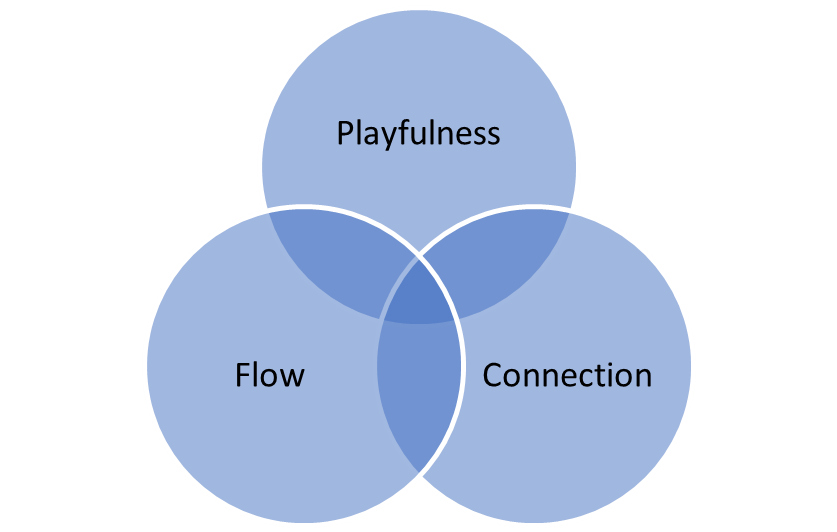
From her interviews with dozens of people from diverse cultures, Price says that “three factors are consistently present” when we experience fun, yielding a much more accurate definition than what the OED or Webster’s tells us.

These three terms are “playfulness,” “connection” and “flow.” Where these experiences overlap is the space of “true fun”(see the venn diagram below, provided by Price).

Playfulness,” she says, is not playing games or make-believe but “having a lighthearted attitude, of doing things for the sake of doing them and not caring too much about the outcome. Letting go of perfectionism.” Playfulness means not being defensive and “not taking ourselves too seriously.”

“Connection” refers to “the feeling of having a special, shared experience.” It is possible to be alone when this happens (and so to feel connected to oneself and/or to an activity), but most often, another person is involved—“even for introverts.”

Flow” is a state where we’re so intensively engaged and focused on what we’re doing that “we can even lose track of time.” (e.g. “in the zone” as a musician or athlete).

Price argues that “it’s possible to be in flow and not [to] have fun, like if you’re arguing with someone. But you cannot have fun if you’re not in flow,” she says.

Each of these three factors is enjoyable on its own. “But when we experience all three at once, something magical happens: we have fun.” And that “doesn’t just feel good, it is good for us.”

(i) She says that fun is so beneficial that it “ is not just the result of human thriving, it’s its cause.” For instance, fun is “energizing,” so that when people describe such moments, “they glow: It’s like a fire has been lit inside of them and the energy and the warmth they give off is contagious.”

Whereas “so much of life drains us . . . fun fills us up.”

(ii) Fun requires us to be “present,” or in-the-moment, but doesn’t require meditation, yoga, etc. Apart from presence, there’s no other way that fun can arise.

(iii) Fun also unites us in a “really polarized world.” When we have fun with others, “we don’t see them as having different ethnicities or religions from ours. We connect with them as human beings.” She adds that such a connection is the first step whereby we can begin to solve the world’s problems.

(iv) “Fun also makes us healthier.” Isolation and loneliness can cause hormonal changes in our brains and bodies that increase the risk of disease. But when we have fun, we become “relaxed and more socially connected,” both of which are health-giving. So, Price argues, “having fun is a health intervention.”

(v) Finally, fun is “joyful.” While we read books or listen to favourite music, the truth is that “when we are in a moment of having fun, we are happy.” Price says this: The “secret of long-term happiness may be simply to have more everyday moments of fun.”

In order to have “more fun,” she says, we should do all we can to increase our everyday moments of playfulness, connection and flow.

Here are some ways:

(i) Reduce distractions in order to increase flow. Distractions disrupt flow. The chief source of distraction in 2023 is our smartphones. (Act accordingly!)

(ii) Increase connection by interacting more with other human beings in real life. This is easier and less scary than we (huddled over our phones) tend to fear.

Interaction starts by making eye contact with someone. “Say ‘Hello,’” Price advises. If that goes well, introduce yourself. From there, ask an interesting question (e.g. “What’s one thing that delighted you today?”)

(iii) Increase playfulness “by finding opportunities to rebel.” This doesn’t mean becoming a total iconoclast, but to show “playful deviance,” to “break the rules of responsible adulthood” and “give yourself permission to get a kick out of your own life.”

(iv) Finally, Price recommends that having fun should be a “priority.” Try to reproduce the circumstances (including other people’s presence) that have created fun for you in the past. Make some time in your schedule to have fun. “Treat fun as if it’s important, because it is,” she enthuses.

Fun brings “more creativity, more productivity, more resilience,” Price says. Fun can make us, as she claims,  a better spouse, parent and friend.

Fun is needed during every month of the calendar, but reading Price’s insights on it may help you enjoy summer even more!

Fun, she concludes, for anyone still puzzled by it, is “a distillation of life’s energy. And the more often we experience it, the more we will feel that we are actually alive.”

Now what would be better than that, this summer?

And now it’s your turn: do you agree with Price’s definition of fun and why it matters? 

Please write in; I’d be delighted to hear from you!

++++++++

STORYTELLERS’ CORNER . . . . 

STORYTELLERS’ CORNER: Words, stories, riddles and articles on speaking, listening, writing and editing . . .

The case of “lit” versus “lighted,” with America’s “Grammar Girl,”

Mignon Fogarty

In a recent blog on modern English usage, American wordsmith, “Grammar Girl” Mignon Fogarty, observed that there are now two forms in use of the simple past tense of the verb “to light.” Have you noticed this?

I overheard someone in a local cafe recently, commenting that the smile of her (undisclosed) partner “lighted up the room.” That form of the simple past tense was grating, and I thought to myself, “it should be ‘lit up the room!’ ”

But Mignon Fogarty suggests otherwise. In her blog this week, she writes that “to light” is a “regular verb,” so that we can write its simple past tense by adding “-ed.” Therefore, we can correctly say and write “lighted.”

However, we can continue to use “lit” for the past tense, which remains the more common form.

Fogarty says that in ancient times, “people said they lit candles.” Over time, people started saying they “lighted candles.” Unusually, “around 1900, people switched back to using ‘lit’ as the past tense.” While “lit” remains “the more common form today,” “lighted” is not incorrect.

Has this usage tip enlightened you? Which form best lights you up (Ha ha!)?

Do you have an, idea, problem or joke involving any aspect of language or communications? Please share it with me; I’d be delighted to use it in an upcoming issue. 

++++++++

SHOP NEWS:

My candidate for “Entrepreneur of the Month” was unable to share his information in time for press, but no matter.

Special thanks go out this month to Lisa Focardi, Community Development Worker at Saskatoon’s Open Door Society (SODS). An Italian-Canadian immigrant, Lisa capably organizes (amongst many programs) the volunteer-led conversation circles, throughout the calendar year.

Her organizational efforts and generosity with others make sharing conversation skills with newcomers a great pleasure. Thank you, Lisa!

Are you a native speaker or are you otherwise fluent in English? Do you have 60-90 minutes each week to share your skills with others? Please drop me a line and I will connect you with Lisa, who is always glad to have more volunteers on board.

++++++++

And hearty congratulations to my colleague and friend, the multi-talented writer, web designer and athlete, Ashleigh Mattern, who recently launched her first novel, a young adult fantasy, called Magicked Born. Reading to a packed room at McNally Robinson on June 28th, Mattern spoke about various aspects of writing fantasy, including how journalism has contributed to the process.

I recommend Magicked Born highly (it’s a page turner!) and congratulate Mattern for not abandoning the project (which was under development over some 15 years), even when other work and life seemed to move in non-conducive directions. Congratulations, Ashleigh!

++++++

And special thanks this month to Professor Emeritus, Bob Calder, and fellow writer, Paula Jane Remlinger, who recently shared a lovely, very FUN two-hour visit with me, over summer refreshments.

We reminisced a little about our past studies,  favourite writers and current projects, thereby bridging the gap between  Calder’s extensive academic career and the non-academic writing that Remlinger and I (former students) now do.

Catherine Price would have approved of flow, connection and simple playfulness of our conversation.

Remlinger writes and publishes poetry and fiction, while also penning reports for a living, for the SK Human Rights’ Commission.

Calder (“Bob” to us)  has just completed the editing of a scholarly book on the film adaptations of  W. Somerset Maugham’s novels, which is forthcoming from the U of Wisconsin Press. He is also deeply involved in writing a memoir of his 40+ year career as a university English teacher.

I  cannot imagine two more engaging  interlocuters than these two, on a quiet July afternoon. All three of us left the table energized to return to our reading and writing!

Thank you, to both Bob and Paul Jane. And let’s meet again before winter returns . . . .

++++++++

There are always new businesses, people, non-profits and entrepreneurial programs to promote.   

Please write me to share your success stories!

I’m excited for what’s ahead in our entrepreneurial and literary community.

But for now, this is a wrap for mid-July!

ABOUT US:

Between 2011 and December 2018, Elizabeth Shih Communications chronicled the stories of B2B marketing and communications on the Prairies and across the country.

Effective January 1, 2019, I rebranded as “Storytelling Communications.” I now help local newcomers to secure better jobs by improving their language skills; I help SMEs close more sales by communicating more effectively; and I tell the legacy stories of major companies.

Interested in learning more? Please contact me through my CASL-compliant website (www.elizabethshih.com).

After I receive your message, I’ll be pleased to discuss projects with you!

Please visit my website for more information (also to be found at  www.storytellingcommunications.ca).


Facing rejection? How to cope, in this month’s issue of ‘Tell Your Story Newsletter’

June 2023 Vol 5 Issue 6

Tell Your Story Newsletter (TYSN):

Specializing in Entrepreneurial and Linguistic Communication

Let me teach you to tell your story!

IN THIS ISSUE:

ARTICLE 1: Facing rejection? How to cope,  in this month’s issue 

STORYTELLERS’ CORNER:

 ‘The Beaverton’ keeps us laughing

SHOP NEWS

ABOUT US

++++++++

Welcome Mid-June 2023!

“Summertime, and the livin’ is easy”

–Heyward and Gershwin

As we enter mid-June, we approach the longest day of the year. And since we have lived with premature, summer-like weather for most of the last month, Saskatoon has unfurled her natural beauty: trees have “greened” up, and the flowering varieties have blossomed with loveliness. Has the luxurious scent of lilac accompanied you (as it has me) through daily walks in the neighbourhood?

. . .Across the city, the water parks have extended their hours, to the delight of young children; splendid garden centres have sold their best perennials and bedding plants; the Children’s Festival has come and gone (and this year wasn’t rained out); . . . . And promotions for our city’s “Jazz Festival” traverse the airwaves and internet.

 It’s true that chronic crises like homelessness, addiction and our broken health-care system fill a good deal of our news and warrant our immediate attention and action. Kudos to Marketing Maverick Sara Wheelwright for publicizing the plight of Saskatoon’s homeless and those with addictions by participating in the “Sanctum Survivor Challenge,” last month. . . .  And yet, notwithstanding that pain, the splendour of an early summer in the loveliness of Saskatoon has nonetheless turned Heyward and Gershwin’s famous ode–“Summertime”–into an earworm.


Even as we read, write and record stories in the media that often include loss or pain, can we also find moments of lightness in this season?


What will you do, to observe June—arguably the most beautiful month of the year—before the intense heat of July and August succeeds it?


In Article One, this month, I discuss the challenging topic of creative (and other) rejection, drawing on a recent article by social psychologist Thomas Smithyman, in the online journal, “Psyche.”


In “Storytellers’ Corner,” we visit some of the headlines of “North America’s Trusted Source of News,” “The Beaverton.” Those jokesters joined Twitter in May, 2010 and have had us laughing, ever since.


And in “Shop News” I thank some long-deserving colleagues in my professional circle, and also feature “Entrepreneur of the Month,” Paola Chiste, of Beppi’s Gelato.


Whether you hike, camp, glamp, swim, cycle, garden, harvest local mushrooms, fiddleheads or haskaps; or whether you partake in activities that transcend the seasons of our beautiful province (e.g. “Word on the Street” will return sooner than we think), I wish you a marvellous start to summer, good readers.

May the lightness of prairie sunshine and the scent of fresh rain fill your senses and nourish your souls this season.


Sincerely,

Elizabeth


Principal

Storytelling Communications

www.elizabethshih.com


++++++++

Article One: Facing rejection? How to cope, in this month’s issue of  ‘Tell Your Story Newsletter’

Whether we get fired from a valued job, “dumped” by a spouse, or forced to close an unprofitable business (to name only three examples),  rejection happens to us all.

Our much-laboured manuscript gets rejected by several publishers. A “blind date” set up by friends (or the internet) goes sour quickly. An application for a professional award fails. Or we can find ourselves excluded from a position we covet, writes clinical psychologist, Thomas Smithyman, in a recent issue of “Psyche.”

Most of us feel the pain that comes with rejection very deeply and work hard to try to prevent its recurrence. But that’s seldom possible and avoidance results in “people . . . giv[ing] up the pursuit of things that matter most to them.”

Social psychologist Mark Leary writes that “the ‘hurt’ feelings of rejection arise when an event suggests to you that someone doesn’t value [your] relationship with you as much as you want them to.”

Rejection is a universal experience, affecting all of us. Those who study brain imaging have found that the pain of different kinds of rejections is (according to Smithyman) “processed in similar ways” by our brains as when we feel physical pain. We lose self-esteem, may become hostile, repeat negative thought patterns (although rumination retriggers the pain of the original rejection) and we often isolate ourselves from others.

Yet there are healthy and reasonable ways to recover from rejection. Smithyman cites strategies that “can help you to heal and move on.”

He says that by learning to cope with rejection, we can feel more resilient about taking risks “in the pursuit of meeting [our] social needs.”

These techniques borrow from mindfulness, self-compassion, and cognitive behavioural therapies.

There is no expiration date on social suffering. Smithyman says he’s worked with patients who feel the pain of rejections that occurred years earlier. He recommends these strategies:

(1) Since rejection delivers a blow to our sense of belonging, it’s logical that we can recover by receiving “whatever social support is available—such as love and compassion” from someone else in our community—even if it comes from a different area of our lives. A friend or relative can restore our sense of belonging, after we break up with a partner or spouse, thereby

preventing depression and anxiety. Having someone caring listen to your experience is a powerful experience, even if it will not “solve the problem.” (He suggests here psychotherapy or psychoanalysis).


Even if we aren’t able to discuss rejection with others in our lives, simply “spending time with them” can replenish our self-esteem and distract ourselves from ruminating over the rejection.


But not everyone has enough social relationships that we can trust to get through the rejections we face, so that we may not find it easy to seek sufficient support.


(2) Mindfulness, whereby we “step back and notice what [we’re] feeling,” rather than getting lost in pain, can provide some distance from the pain of rejection.


Smithyman writes that the difference is “between being outside during  powerful storm, and being inside a comfortable cabin, watching the storm through a window. It doesn’t . . . prevent the storm, but it gives you a refuge from which to observe it.”


Naming and differentiating negative emotions can help (e.g. anxiety is separate from anger and from shame)

can reduce distress among people who have suffered social rejection: “There seems to be something about simply naming emotions that helps reduce their intensity—possibly because it offers a sense of control and facilitates the selection of more effective coping responses.”


(3) After we’ve gone inward to recognize some of our feelings over rejection, we can interpret and make sense of our “rejection experiences” with self-compassion. We need compassion for ourselves, since the strong emotions that arise from rejection are not always reasonable or helpful to us—i.e. we tend to blame ourselves or think we are “unintelligent” or unlovable. Having been declined once can cause some people to assume a “lifetime of ostracism and failure.”


Writing exercises, such as a letter to ourselves can help us to show compassion for ourselves: we take the position of a wiser, older, compassionate self, writing “to the vulnerable, suffering part of yourself.” Smithyman notes that “both offering and receiving compassion have been shown to help regulate psychological distress, and you’re doing both in this exercise.”


(4) Once we’ve dealt with some of the heavy emotions that follow rejection, we can respond to it with “problem-focused coping.” This means we develop a plan to “solve our problem” of having been rejected, to avoid emotionally driven but anti-social responses, such as withdrawal or “lashing out.”


Smithyman recommends a four-step model for problem-focused coping: (i) clarify the problem; (ii) brainstorm a range of possible options for dealing with it; (iii) consider the benefits and drawbacks of each option; (iv) identify the best option and which tangible steps we’ll take to achieve it.

Once our emotional response to rejection has eased by earlier responses (1, 2 and 3), we can summarize the problem in rational terms (e.g. “I asked someone online for a date but they never responded. It mustn’t have been a good fit or good timing for them.”) You then recognize that you still want to meet someone to date and brainstorm as many solutions as you can.


For instance, we might “try to repair” a rejection, when it results from conflict with a friend, relative or long-term romantic partner.

Other times, it will be better to “accept and heal” from a rejection, when “situations cannot be fixed.” If trying to repair a rejection will only lead to a repetition of rejection experiences, then turning to “acceptance and taking care of ourselves” is a better strategy. Mindful and self-compassion practices can heal us, such as spending time with other people, spending time in nature, practicing spirituality, reading, etc.


We can respond to rejection in a very effective way by “creating new opportunities for meeting [our] needs” (Smithyman). He observes that “if a group of our friends” keeps excluding us, we can look to others for social connections and to satisfy our need to belong, such as among other friends, family, colleagues, etc. and by methods like texting/calling, inviting, sharing some aspect of yourself and asking about the lives of these others.


Job loss is often like losing at dating, because we must take concrete steps to find new opportunities, by continuing to look and trying to connect with others.


Smithyman notes that people can sometimes become preoccupied with rejection in close relationships, developing what he terms “rejection sensitivity”—a heightened concern about being rejected by people who are important in your life. This can become self-fulfilling, so that great fear of rejection can underpin behaviour that drives others away, repeating the rejection that is so greatly feared and then reinforcing the “rejection sensitivity,” itself.


This kind of experience (due to past experiences of rejection, especially early in life) can be coped with according to steps one to four, but especially working to “create space between emotional triggers and habitual, defensive responses such as yelling, or isolating.” That space can be created by self-soothing and assessing the reality of the situation, feeling emotions but being skeptical of assumptions we could make about others’ motivations. Adopting the perspective of a compassionate outsider can help to interpret situations of pain or loss without being oversensitive to rejection.


Rejection is such a large part of business and entrepreneurship that one of Canada’s top marketers of all time–Terry O’Reilly– and team (including several family members) have started an entire podcast on it, called “We Regret to Inform You: The Rejection Podcast,” featuring fascinating stories of successful people who “triumphed over debilitating career rejection. And the insights those rejections provide.” Smithyman says solace can be found as that podcast “shed[s] light on the valuable insights gleaned from each person’s perseverance through adversity.”


Recommended listening!


Finally, Smithyman also recommends two other podcasts that feature rejection–“the Moth” and “Mortified”–some of which include stories that, in their humour and emotional authenticity, can provide cathartic results.


And now it’s your turn: Have you felt the sting of rejection recently? Do you think Smithyman’s suggestions would help? Please write in; I’d be delighted to hear from you!

++++++++

STORYTELLERS’ CORNER . . . .

STORYTELLERS’ CORNER: Words, stories, riddles and more on writing and editing . . .

This month: “The Beaverton” keeps us laughing

This month, I give some long overdue praise to the satire of “North America’s Trusted Source of News,” “The Beaverton.” Its Twitter page tells us that it joined Twitter in May, 2010.

Along with some 20 contacts of mine on Twitter (quite possibly including you, good reader), we’ve been laughing, ever since.

In good times, in bad times, in every kind of times, “The Beaverton” has had us chuckling or guffawing through our Twitter feed.

Here are some of their all-time classic headlines:

  • “7 regional Canadian dishes that are poutine”;
  • “University student working menial summer job unaware it will be permanent job after graduation”;
  • “ ‘Politics don’t affect me,’ says guy complaining about inflation, the price of gas, the housing market, cost of living, ER wait times, and crippling student debt”’;
  • “Fugitive Trump’s attempt to flee to Mexico thwarted by big wall”;
  • “Toronto Goodwill asking people to stop donating Leafs jerseys.”

More recently:

  • “Canadians celebrate summer with nationwide campfire”;
  • “7 facts about Pierre Poilievre that probably aren’t true but we refused to be briefed on the actual situation”;
  • “First Canadian to orbit moon [Jeremy Hansen] in attempt to find affordable housing”; and
  • “Chinese government asks Elections Canada for tax receipt”  . . . & on and on “The Beaverton” goes . . . .

Besides taking donations to keep their social media satire going., The Beaverton has plenty of promotional  merchandise available for sale on their website, and even offers “a series of Satire and Comedy Courses” via Zoom, including a six-week class that covers all forms of professional satire writing, in partnership with Toronto’s “Comedy Bar.”

Endorsements for the group’s publications and work include those from the late Pierre Berton (beyond the grave), a selfie-seeking Prime Minister Justin Trudeau, and “The guy who does all the History Minutes.”

Visit thebeaverton.com/news/national/  for more medicinal laughter, dispensed especially for these challenging times.

Do you have a concept, idea, problem or joke involving any aspect of writing or communications? Please share it with me; I’d be delighted to use it in an upcoming issue. 

++++++++

SHOP NEWS:

Special thanks this month (and every month, really) go to my wonderful IT specialist, Jordon MacKenzie, whom I met during his tenure as principal for ABA Technology Solutions.

Jordon was a fellow entrepreneur-in-training at the Praxis School of Entrepreneurship some five years ago, and has advised me and answered my tech-related questions  ever since. He’s done so with expertise and judgment that are second to none.

After reducing hours for ABA Technology Solutions and after providing IT related services at Audio Warehouse for several years, Jordon now works for another IT company, but continues to assist his freelance friends.

In his spare time, Jordon can be found with his wife, Michaela, and their canine fur baby, Ozzie (a Pyrenees-Maremma cross). The latter sometimes enjoys a “doggy cone” of gelato at Beppi’s on Broadway!

++++++++

Special thanks to another Praxis alum, Jolene Watson. of Clarity Coaching and Development, for sharing with me some of the resources she uses to teach (and engage in) networking, this quarter.

Considering sources like the Myers Briggs Type Indicator (of personality) for newcomer students has been crucial to their preparation for the workplace.

+++++++

I must again extend words of gratitude to parish nurse Laura Van Loon, who tirelessly works for families and individuals in need of better health care. Thank you, Laura, and I will share my support in upcoming months, I’m sure!

+++++++

This month, I also thank my colleague and mentor, Steve Cavan, who has suggested great alterations to curriculum that will make our  “Workplace Employment Readiness” classes more useful for those newcomers.

++++++++

A word of encouragement and wish for healing this month to my French ESL student, Eliane, who has been a wonderful interlocutor for the past 14 months and who is struggling with Covid in her home, south of Paris: Je vous souhaite un bon retablissement, mon amie!

++++++++

And I remain grateful as ever for the friendship of local novelist Lesley-Anne McLeod and her daughter, the multi-talented Kat Bens. When life amidst the 21st century state of elder care in Saskatchewan feels overwhelmingly hopeless, these women’s resilience and generosity encourage me to endure.

++++++++

Entrepreneur of the Month: Paola Chiste, of “Beppi’s Gelato”. . . . 

Just one parking lot from the corner of 10th St. and Broadway Ave is located one of Saskatoon’s favourite specialty eateries, “Beppi’s Gelato.”

Gelato (an Italian style ice cream) is lower in fat, sugar, and made with more natural ingredients (such as fresh fruit) than ice cream (which can be half air!). With its dense texture, gelato is meant to be consumed in smaller portions, too. These are all good news for those of us wanting to shed some of last winter’s weight!

Born in Canada to Italian immigrant parents, founder and chief gelato maker, Paola Chiste,  returned to Bologna to study at “Gelato University,” after losing her job at the University of Saskatchewan.

When studying in Bologna, Chiste learned how to make authentic Italian gelato, as well as how to set up and run gelato shop. She named the shop after her “Nonno” (grandfather), “Beppi.” The shop opened in 2019.

Chiste and her husband used to travel to Calgary to find Italian grocery stores, because their products were hard to find in Saskatoon. So they started to order Italian delicacies for the market side of Beppi’s.

Now gelato lovers can also buy Rummo pasta, a variety of olives and preserves, handmade chocolates, cookies made on-site, vinegars, olive oils and other, unexpected treats.

“Beppi’s’” is known for creating sugar-reduced, plain gelato, available in free mini-cones for all canine customers. “Doggy cones” have become the eatery’s famous offering and a “great marketing” tool, Paola says.

Beppi’s is open 9:00 am to 9:00 pm, seven days a week during the summer (starting May 1st) and during winter (Tues-Sun) from 10:00 am to 6:00 pm.

During winter months,

Beppi’s also offers gelato for take-out, featuring nine standard flavours plus two monthly features. Hot Italian coffees and other drinks are also available then.

Beppi’s is a summer favourite, for visitors as far away as Penticton and Halifax, Chiste reports.

What flavour of gelato will you try? See you in line and bring your canine friend(s), too!

Beppi’s Gelato

https://www.beppis.ca/

616-10th St. E, #1

(306) 227-2214

Email: beppis@sasktel.net

FB and Insta: @beppisgelato

++++++++

There are always new businesses and entrepreneurial programs to promote.   

Please write me to share your success stories!

I’m excited for what’s ahead in our entrepreneurial community.

But for now, this is a wrap for mid-June!

++++++++

ABOUT US:

Between 2011 and December 2018, Elizabeth Shih Communications chronicled the stories of B2B marketing and communications on the Prairies and across the country.

Effective January 1, 2019, I rebranded as “Storytelling Communications.” I help new and economic immigrants to secure better jobs by improving their English skills; I help SMEs close more sales by communicating more effectively; and I help major companies write their legacy stories.

Interested in learning more? Please contact me through my CASL-compliant website (www.elizabethshih.com).

After I receive your message, I’ll be pleased to discuss projects with you!

Please visit my website for more information (www.storytellingcommunications.ca).


On Creative Writing in the Age of AI in this month’s issue of ‘Tell Your Story Newsletter’

May 2023 Vol 5 Issue 5

Tell Your Story Newsletter (TYSN):
Specializing in Entrepreneurial and Linguistic Communication
Let me help you tell your story!

Welcome Mid-May 2023!

After weeks of unseasonable cold during March and April, the past week or two has brought near record-breaking warmth to Saskatchewan. During April, our temperatures varied within one week from -30 degrees to above 20 degrees Celsius! And as I’ve prepared this issue of “Tell Your Story Newsletter,” daily temperatures have risen to nearly +30 degrees — all signs of
climate change.

And yet the sunshine and warmth feel so welcome, after another interminable prairie winter–and a Covid one, at that.
With May, the grass of neighbourhood yards has started to “green up,” robins are taking flight (and charging our windows) and Saskatchewanians are breaking out flip flops, bermuda shorts, and our ever-important sunscreen.

As the ground finally thaws, gardeners like my friends and colleagues, Ashleigh Mattern; Julie Barnes; Laura Zink and Tom Yates prepare to plant the seedlings they started last winter, or the inviting annuals and perennials already on “show” in our favourite garden centres.

Painfully aware that Covid-19 is not behind us (as hospital wards still show), some of us continue to “mask up” when visiting hospitals, but also in grocery stores and other indoor settings where many congregate. Covid has not “done” with us, although outdoor activities bring us more of a reprieve.

In “Article One,” this month, I visit an influential posting by Jessica Lam Hill Young over LinkedIn, on how creative writers must adapt to Artificial Intelligence (AI) or face obsolescence.

And in “Storytellers’ Corner,” I visit a smart networking pointer from American psychologist and marketing guru, Robert Cialdini.

I wish for you, good readers, time to enjoy the remainder of spring, before summer (too quickly) takes its place.

May we all be conscious of the blessings that still grace our lives, even in these late pandemic times.
Sincerely,
Elizabeth
Principal
Storytelling Communications
www.elizabethshih.com
++++++++
IN THIS ISSUE:
ARTICLE 1: Creative Writing in the Age of AI
STORYTELLERS’ CORNER: Dr. Robert Cialdini on Persuasion
SHOP NEWS
ABOUT US
++++++++
Article One: Creative Writing in the age of AI

Much ink has been spilt lately over the rise of AI, notably with ChatGPT and its competitors.

In a posting on May 5th on the social media network I most often teach to newcomers, LinkedIn, SEO specialist, tech marketer, copywriter and strategist Jessica Lam Hill Young wrote persuasively about how AI will genuinely change the landscape for copywriters and content writers (including me).

From her office in Hong Kong, Lam Hill Young contends that 90% of writers will eventually be replaced by AI, especially for relative newcomers to the field, who have “under five years of experience.”

She says that when reviewing recent applications for an opening of a writer for her team, she repeatedly saw “the same red flags,” such as generic cover letters (from templates); blog writing focused more on SEO than on in-depth thinking (relying on repetitive phrasing, obvious statements, impersonal writing); and unclear writing that is also “clunky,” and without “brevity,
conciseness and elegance.”

She calls for a “radical paradigm shift” so that “copywriters and content writers become marketers, not writers.” Here are her seven tips for creatives who want to avoid career obsolescence, as AI deepens and intensifies its influence:

(1) Instead of taking instructions from a client (as writers often do), become “a marketer” who “deeply understands and persuades the target reader to take action.” This matters, because AI cannot “feel and speak to the pain points of your reader with human empathy.”

(2) Develop a niche in topics that AI struggles with, such as developer content, specific B2B audiences (yay!), technical content, tech thought leadership and medical writing, amongst others.

A painful reality, Lam Hill Young says, is that for “wellness or B2C” writers, “it’s game over, soon.”
(3) Search back at original data on your topics, get first-person insights (by interviews or webinars) and “read thought leadership” in the field you’re writing about (“Forbes,” the “Harvard Business Review,” “The Economist” and “The New York Times” are all great places).

(4) Diversify your skills so that you don’t just write content/information-based writing: “Master copywriting, website copy, email copy, social media posts, nonfiction writing, etc.,” because “these are all interrelated.”

(5) Don’t crank out “volume.” Good marketing writers don’t produce 6000+ words/week in which nothing stands out. She recommends that we raise our fees and “spend more time on 2000 words/week that actually matter.”

(6) If you’re making the mistake of charging by word count, stop! It “devalues your work as an output of volume.” Instead, write projects that are not about meeting a target length.

(7) Spend all your free time playing with AI so you can understand its limitations. Actually use ChatGPT: when you feed it your prompt, does it write better than you? While marketers can build “briefs” (i.e. summaries, guides or arguments that present key points to stakeholders), Lam Hill Young writes, genuinely great writers “should OWN that brief. For example, the hiring marketer can give a bit of context, topic, audience, campaign goals, etc. . . .
but NOT tell the writer what to write and the outline, etc. The writer should be the one deciding on angle, messaging, sources, structure, storytelling, etc., after diving deep into the subject matter.”

And, she adds, “the writer should be a savvy enough marketer to tell the hiring manager when there are problems with the content request.” Friction will definitely result.

Writers who are thought leaders will take an email or a question or a prompt from an editor and “run with it,” successfully. Lam Hill Young says she seldom finds that amongst freelancers, and only with in-house creatives.

World white paper giant Gordon Graham (a Canadian with whom I share my website designer) added further that more work will transpire for well-read editors who can polish up drafts written by AI. And “there will be lots of opportunities for writers/editors who can write with AI and then humanize its drafts.”

Creatives need to plan writing “strategically around context, audience and business goals.”

Gone are the days of Googling sources to create content. ChatGPT and its rivals are mastering that, as we speak.

Currently, Lam Hill Young writes, ChatGPT doesn’t work to develop client content on highly specialized topics, but writers whom she recommends, Jacob McMillen and Julia McCoy, are exploring those limits. McMillen responded that AI can create remarkable writing for long-form
if it is tackled one section at a time. (But AI’s capacity grows rapidly and will soon do more!)

So researching with paid subscriptions, listening to podcasts (Eric Anderson’s, Christina Cherneskey and Lenore Swystun’s are faves of mine), listening to webinars and interviewing real people are the best ways to write original, interesting and useful content.

Later last week (May 11th), Lam Hill Young (linchpin that she is) added five resources for those of us striving to learn about AI, while living “real lives”:

(1) The Neuron – AI News –is a weekly AI newsletter collecting the latest and most popular in AI developments by expert curator and journalist Pete Huang. You can find them in one handy email “before they pop up in your feed.”
(2) Prompts Daily –A “Prompts Engineer” is now a career! Get all the latest prompts in a daily newsletter and creative ideas to get the most out of AI tools, using those prompts.
(3) AI Chat Slack channel by Ruben Hassid. This channel has a brilliant tagline: ” ‘Master AI before it Masters You’ .” This can be a great community chat for AI-related matter.
(4) The Superhuman newsletter by Awais Khan. This is new to Lam Hill Young, but she finds reason to keep reading. What do you think?
(5) There’s An AI For That is a huge directory listing 4,120 AIs for 1,158 tasks and more, updated daily. Whatever you need, AI will be on it, if it hasn’t already mastered and archived the field. https://join.theneurondaily.com/

And now it’s your turn: what are you using AI to do, in your work or business? And with what results?
Please write in; I’d be delighted to hear from you!
++++++++

STORYTELLERS’ CORNER . . . .

STORYTELLERS’ CORNER: Words, stories, riddles and articles on marketing, writing and language learning
This month: Dr. Robert Cialdini on Persuasion

The great psychologist and marketer, Dr. Robert Cialdini (best known for his book, Influence), recently posted on LinkedIn a method for applying persuasion to networking.

When someone is introducing you to another person, group or larger audience, Cialdini suggests these pointers:
(1) As a receptionist for a company, a woman (let’s call her Lucy) might introduce clients to colleagues by saying, “Do you have a question about commercial real estate? I’ll put you through to Peter.”

(2) Lucy’s supervisor asked her to change her introduction to: “I’ll put you through to Peter . . . he has 20 years of experience and is the go-to expert in this region.”

(3) By making this change, the securing of appointments increased by 20%. And signed contracts went up by 15%.

All the receptionist did was bring Peter’s genuine authority to awareness.
Because Peter did have that experience and he was in fact the expert in this field. So this leaves us with an idea for how to bring authority to the surface in your organization: Cialdini says we should always answer these three questions:

(i) Who should introduce me? If possible have someone else introduce you and your credentials, so you won’t be seen as a braggart.

(ii) When should I be introduced? Try to be introduced right before you speak, whether in a meeting or at a presentation.

(iii) What credentials should I give my introducer to use? Your expertise, experience, titles, awards, achievements can be mentioned . . . as long as they’re relevant to your message.
Don’t be (too) modest. Leveraging strong, relevant credentials will help your audience to choose you for their project(s).

Do you have an, idea, problem or pointer involving any aspect of language, communications or marketing? Please share it with me; I’d be delighted to use it in an upcoming issue.

++++++++

SHOP NEWS: 

At risk of boring my readers by repetition, I need to express particular gratitude again this month to the staff of (Revera) The Franklin assisted living building, for taking care and sensitivity in welcoming my elderly mother back to her home, after she endured a very trying time in hospital.

Particularly wonderful were Mason and Charmaine in advising me on the gastroenteritis that infiltrated so many seniors’ facilities last winter, which made several residents, including my family member, very ill.

Mason quietly and masterfully disinfected the suite involved and Charmaine advised on protocol for hospitalization in a very stressful time: Thank you, to you both!

While the experience I witnessed at Royal University Hospital demonstrated the breakdown of hospital care that fills the daily news, I also owe tremendous gratitude to parish nurse Laura Van Loon, who advised me on how to emerge from a terrible lack of care to safer rehabilitation at home.
Once again, thank you, Laura!
+++++++
Entrepreneur of the Month: Stephen Cavan
. . .
Based in Saskatoon and soon to be Calabria, Italy, Stephen Cavan has been a highly motivated entrepreneur in several fields, over the years:

While teaching Greek and Roman Classics at U of S, he began a hobby of brewing beer at home.

But the lack of available supplies motivated him to start his own business, opening Paddock Wood Brewing in 1995.

Steve’s purpose was to sell the best ingredients for making beer. Selling ingredients eventually transformed into selling the finished product. By 2012, his hobby had yielded over $1M in sales in Canada and employed a staff of 15.

The market for craft beer grew very slowly and most local bars hesitated to offer it. So in 2012, Steve opened a bar–The Woods Alehouse–to showcase the world of craft beer. But managing a bar/restaurant with roughly 30 employees became what he terms a “hot potato.”

He was happy to sell that business after four years.
Most recently, since 2019, Steve has retired from brewing and become certified to teach English as a Second Language (ESL). Through his wonderful wife, Kathleen (formerly of the English Department and St. Andrew’s College, U of S), I began to discuss with Steve my own interest in ESL.

Steve has been teaching privately on the “italki” platform, since 2020 and has mentored me to do the same, while we both teach some in-person classes on business and academic topics.

Steve’s current plan is to teach English from retirement in Italy, combining in-person and online classes to a growing number of intellectually curious and admiring students.

Thank you, Steve, for your commitment to the ESL industry. And I hope we will collaborate in the future, as well!
There are always new businesses, non-profits and entrepreneurial programs to promote. Please write me to share your success stories!
I’m excited for what’s ahead in our entrepreneurial community.
But for now, this is a wrap for mid-May!

++++++++

ABOUT US:

Between 2011 and December 2018, Elizabeth Shih Communications chronicled the stories of B2B marketing and communications on the Prairies and across the country.

Effective January 1, 2019, I rebranded as “Storytelling Communications.” I now help newcomers to Canada land better jobs and economic immigrants to secure contracts by improving their English skills; I help SMEs close more sales by communicating more effectively; and I help major companies tell their legacy stories.

Interested in learning more? Please contact me through my CASL-compliant
website (www.elizabethshih.com). After I receive your message, I’ll be pleased to discuss projects with you!

STAY IN TOUCH:

Follow us on Twitter
Become a Facebook fan
Subscribe to my blog
Contact us


Overwhelmed by Spring Cleaning? What to do, in this month’s issue of “Tell Your Story Newsletter”

April 2023 Vol 5 Issue 4

Tell Your Story Newsletter (TYSN):
Specializing in Entrepreneurial and Linguistic Communication
Let me teach you to tell your story!

Welcome Mid-April, 2023!

After what felt like an interminable winter, we felt on April 8th an ushering in of more seasonable temperatures and sunshine. Nights of minus 20 degrees (Celsius) have finally yielded to minus single- or even plus-digit temperatures. And Saskatchewanians have breathed a collective sigh of relief (and we hope that this week will bring rain, not snow)!

Although it is brief or even non-existent some years (when winter morphs into summer), spring offers small miracles–the return of birdsong, a rapid melt of residual snow, the thawing of the ground for those who farm or garden, and the budding of trees and bushes . . . . Special thanks to those dedicated neighbours who have cleared storm drains this year, so that enormous puddles don’t impede walking, cycling and driving. (Beware those sinkholes!)

And speaking of spring, in “Article One” this month, I’ll discuss the common issue that many Saskatchewanians face this time of year–of “overwhelm” with “spring cleaning”–the need to declutter our living and work spaces.

And in “Storytellers’ Corner” this month, I feature some truly “wretched writing” from expert editors, Ross and Kathryn Petras. Some of it will make you laugh!

And even if spring is a fleeting (barely existent) season in Saskatchewan, may it be a time, good reader, to renew your health by being outdoors, to achieve the culmination of professional accomplishments, and to relax, as summer approaches, with family and friends–all blessings that still grace our lives, even in these late pandemic days.

Sincerely,
Elizabeth Shih
Principal
Storytelling Communications
www.elizabethshih.com
++++++++

IN THIS ISSUE:

ARTICLE ONE: Overwhelmed by spring cleaning? What to do in this month’s issue
STORYTELLERS’ CORNER:
Purple prose to make you laugh from Wretched Writing by Ross and Kathryn Petras
SHOP NEWS
ABOUT US
++++++++

Article One:  Overwhelmed by Spring Cleaning? What to do, in this month’s issue of “Tell Your Story Newsletter”

Entrepreneurs might wonder about the relevance of an article on “spring cleaning” to their lives. But recent articles have abounded on how to improve our workspaces (for work-from-home or hybrid offices) and how to shed the severity of last winter by purging and decluttering!

Spring cleaning, when it involves decluttering, can be essential to this newsletter’s theme of “entrepreneurial wellness.” Whether you dig-in up to your elbows with seasonal cleaning tasks (such as cleaning windows, rugs and boot racks), or whether you delegate such work to others, every entrepreneur needs to know how to pitch and purge. So if your home office (or your entire home) lack order and calm, read on!

In an online article last week, CBC journalist Jenifer Norwell addressed why so many of us find “spring cleaning” a grinding chore. Given that economic challenges in these late pandemic and war-torn years have exacerbated both
rental and buyer housing markets, many people—and entrepreneurs, especially—find we must downsize to live and work in smaller spaces.

Consider the “tiny homes” movement and how living as a minimalist has become desirable for a growing number of people, worldwide.

Either purging and pitching excess belongings in your living or work space, or doing a simple seasonal cleaning, many, many people find “spring cleaning” to be overwhelming. But the work won’t “go away” if we avoid it.

In the CBC article, one interviewee commented: “I am finding things I didn’t even realize I had!” Things you’ve lived without for a year, or maybe even a decade (or more), can and should go “out the door.” You don’t really need that old toaster oven or those back issues from eight+ years ago,
of “Time Magazine” or the Times Literary Supplement.

Canadians across all disciplines have reported that reducing unneeded belongings is the best way to make clearer and better-organized spaces that help us both to be productive (at work) and to relax (in leisure time).

When maintaining a space “takes longer and longer to do, that’s a good sign that it’s time to reevaluate,” says Canadian space organizer, Celeste Imus.
The global tidying-up phenomen Marie Kondo has won followers around the world with her approach to decluttering, in which she shows us how to “pare down [our] possessions,” and only keep what “sparks joy.”

Kondo frames the cleaning/decluttering process as positive, not agonizing, and her approach has benefited those who love minimalism. Some have even become professional organizers—making careers out of training and working with Kondo’s methods.

Economist and writer Tim Harford told Norwell that such reorganizing of your space can work well in a kitchen or bedroom, but not in “dynamic situations”–such as workplaces where there is a constant (high) intake of email, digital or hard copy paperwork, or books. Harford says: “When there’s this constant flow of stuff in and out of a working space, Kondo’s method of asking, ‘Do I
really need this? Does it spark joy?’ does not apply.”

So what can we do to make “decluttering” more manageable? Organizer Celeste Imus provides six tips to succeed in the process:
(1) “Start small”: Begin with a small area, like a closet or dresser drawer, instead of feeling overwhelmed by an entire house, apartment or room. Work by one item at a time, so you don’t over-pitch, she says.

(2) “Take breaks”: Don’t work to declutter, purge and pitch for more than two hours at a time, because after that, our brains stop engaging and we can feel “frantic,” pitching out things we should keep, like passports and birth certificates.

(3) “Declutter with a buddy”: Working with someone you trust will make the process more enjoyable and give you a chance to share stories about your things, after which it becomes easier to get rid of some of them.

(4) “Choose comfort”: Bringing items up to table height and working in a well-lit room at a comfortable temperature can reduce the feeling that decluttering is drudgery. Be aware that decluttering is hard on the body, as well as the mind.

(5) “Customize your process”: Know that some organizational approaches might work well for some homes but not always for yours.

(6) “Cut yourself some slack”: Allow yourself to keep some things because they could be useful later, or just because they have sentimental value. Imus says: “Sometimes it just makes you feel comfortable to have the things you love around you.”

And yet, organizers also warn, that what may start as clutter can become for some a hoarding disorder. Jenifer Norwell asks: “ When is clutter just clutter and when is it a hoarding disorder at work?” Psychiatrists say that extremely severe cases of clutter are associated with clinical “hoarding
disorder,” a medical condition that requires ongoing treatment. Hoarding is a form of obsessive/compulsive disorder, in which an individual finds they cannot discard old possessions, even those that have no value.

Purging your home of excess stuff needn’t mean discarding its stories, altogether. Do consider keeping a few items or pieces that have particularly sentimental value.Consider what life would be like without the public who share stories on “The Antiques Roadshow” on both sides of the Atlantic!

In the end, “for some people. . . if they can clear their abode a little bit, it helps to clear their minds,” says B.C.-based counsellor, Murray Anderson. He concludes: “It’s a matter of having sense and order and being able to make space for other things in your lives.”

And now it’s your turn: do you feel overwhelmed by the disorder of your living and/or working space? Do the above tips help to reduce the overwhelm?
Please write in: I’d be delighted to hear from you!
++++++++
STORYTELLER’s CORNER . . . .

STORYTELLERS’ CORNER: Words, stories, riddles and jokes on Writing and Editing . . .

This month: “Wretched writing”: Ross and Kathryn Petras on ” ‘crimes against the English language’ “

In a 2012 volume aptly called, Wretched Writing: A Compendium of Crimes against the English Language, sibling editors, Ross and Kathryn Peters, define bad writing as “a felonious assault on the English language.”


They continue: “It is the lowest of the low. It plumbs the depths of literature and spelunks in the caves of nonfiction. In other words, it stinks. . . . [It] comes in numerous and quite varied forms and modes . . . . exhibiting a blatant ignorance of the constraints of grammar and . . . exuberantly and
brazenly excessive prose. . . . [It] can be marked by overusage of literary tropes or underusage of good taste.”

Such writing, they add, is regrettably “timeless,” implicating writers of the past, present and future. Here are some fun(ny) examples to tickle your funny bone this month. If you’ve ever regretted writing poorly, consider that it couldn’t be worse than the following examples:

(1) A blatant case of “purple prose” (i.e. overwritten, under- or un-edited, self-indulgent and excessive writing) comes From Samuel Alexander White’s book, Called Northwest (1943). Every noun in his writing has one or more adjectives, exhausting our imagination:  “Her slim arms, agile as darting javelins, alternately waved and reined, fluttering the open collared, gray, pearl-buttoned waist that she wore with her chamois-colored riding costume and striking tan boots and copper-hued chaps encasing her mobile thighs with whipping jacket
tails.”

(2) Some writers write anatomical impossibilities in descriptive prose:
(a) “She stood at the foot of the stairs, narrowing her eyes and breathing through her hips” (from a short story in The Saturday Evening Post, no date given).

b)“People who leaned over backwards, McCullough thought grimly, frequently fell flat on their face . . .” (James White, All Judgment Fled, 1948).

(3) Some governments and corporations write bureaucratese that says “absolutely nothing about something”: “No unmet needs exist and . . . current unmet needs that are being met will continue to be met” (Transportation Commission on Unmet Transit Needs, Mariposa County,
California).

(4) Faulty translations abound, to the detriment of the English language:
(a) “Here you shall be well fed up and agreeably drunk. In the close village you can buy jolly memorials for when you pass away” (In a brochure for an Italian hotel in the Dolomites area).
And (b) “You are properly exhausted after journey or business work. Worthily divert yourself from boredom and create new sense of perception that makes you completely relaxed and happy, please call on LONGMAN HOTEL where our multifunctional recreations will surely feast your tastes. YOU ARE ADDED WITH FUN. Welcome to Piano lounge, where you could enjoy abundant beverages besides cocktails in an elegant atmosphere while being introxicated With pianists famourse musics from home and aboard. YOU ARE AN EXTRAORDINARY VOCALIST AT KAROKE” (In a brochure from
the Longman Hotel, Shanghai, China).

Do you have a story, riddle or joke on any aspect of writing or communications? Please share it with me; I’d be delighted to use it in an upcoming issue.
++++++++
SHOP NEWS:

Thank you to the administrative and operating staff at The Franklin Retirement Residence (Revera), for working hard to support seniors of all ages and abilities, in their later years. The quality of life, including diet, transportation, social activities, openness to home-care support and
other programming are excellent, and have created a positive home for a senior in my family.


Special thanks to Vinod (Executive Director), Steve, Mason, Charmaine, Dea, Danae, Sharla, Amrit, Bonnie and others whose names I may temporarily have forgotten (with apologies).

Currently, when our senior health care system is woefully neglected and neglectful, assisted living facilities like The Franklin are providing options even for advanced elderly with disabilities in our communities, for which I am deeply grateful.

To tour the various sizes of suites and discuss many options for residents, please contact Daniel Knudsen, at Daniel.Knudsen@reveraliving.com or call (306) 241-1092.

++++++++
And even more overdue thanks goes to the mature care professionals of “Home Instead, Inc.” in Saskatoon, including Starr, Amanda, Lavern, Lil, and administrators Rita, Helen and Marina.

Enabling the elderly to “age in place” in homes that are familiar to them is a tremendous service to our community. Thank you to you all.

++++++++
Another essential supporter has been my faith group’s parish nurse, the amazing Laura Van Loon. Although mandated to work only a handful of hours each week, Laura deftly arranges everything from infant baptisms (at one end of life) to bedside vigils for those in palliative care (at the other).
She continues to be my guiding light as I shepherd an elderly relative through the complex and very broken bureaucracy of our senior “care” system.

Thank you, Laura!

++++++++

Special thanks to Lisa Focardi, organizer of Saskatoon Open Door Society’s conversation circles for newcomers, for welcoming me back as a circle leader, on a schedule that will accommodate my commitments. Helping newcomers with language training brings me (and so many ESL teachers)
much joy.

++++++++
Entrepreneur of the month: Meet Silvana Cracogna, ESL teacher and administrator, Global Infobrokers! This month’s entrepreneur is my fellow ESL teacher, Silvana Cracogna, coordinator and facilitator of language programs at Global Infobrokers (home of the Praxis group of schools).

Silvana has been the primary assistant of Praxis -Global CEO Monica Kreuger for over 10 years, but prior to that taught ESL to various students, including children in a Korean elementary school.

Born in Argentina, Silvana moved to Saskatoon with her parents when she was eight years old.  She earned a BA in Spanish at the University of Saskatchewan and an MA (focused on Latin American literature), at the University of Ottawa.

While at university, Silvana was a teaching assistant, taught ESL to a Pfizer employee from Colombia, and to two RCMP employees. She was later certified in a 150 hour TESOL/TEFL course through Global Leadership College,
while she was also working for Praxis.

While Silvana prefers teaching adults, she has also worked with teenagers and children, including some with varying abilities.

Silvana looks forward to taking new ESL students, although she currently works full-time for the Praxis School of Entrepreneurship. She comments on why she loves teaching ESL: “I love languages and helping people acquire the
ability to work within a new language. . . “There is nothing more fulfilling than seeing the lights go on, as students navigate the world with new-found skills.”

Thank you Silvana for your commitment to the ESL industry. And I hope we can collaborate in the field soon!
++++++++
Four years after undertaking nine months of programming through startSMART at the Praxis School of Entrepreneurship (PSE), I continue to find fruitful relationships with talented individuals, including Silvana Cracogna and Deanna Litz.

All of this is only possible due to the vision of Global Infobrokers’ CEO, Monica Kreuger; VP Global Infobrokers Inc., Brent Kreuger; and Praxis program administrator and Principal, EDM Business Services, Elaine Mantyka.

++++++++

ABOUT US:
Between 2011 and December 2018, Elizabeth Shih Communications chronicled the stories of B2B marketing and communications on the Prairies and across the country.

Effective January 1, 2019, I rebranded as “Storytelling Communications.” I now help newcomers to Canada land better jobs by improving their English skills; I help small-sized businesses close more sales by communicating more effectively; and I help major companies tell their legacy stories.

Interested in learning more? Please contact me through my CASL-compliant
website (www.elizabethshih.com).

After I receive your message, I’ll be pleased to discuss projects with you!
Please visit my website for more information (www.storytellingcommunications.ca)